

Texas changed the question
For much of the data center boom, the race in Texas has been about securing the ingredients needed to build: land, capital, fiber, equipment and, increasingly, electricity.
Now Texas itself is becoming another variable in that equation.
On August 3, Governor Greg Abbott directed ERCOT and the Public Utility Commission of Texas to take a closer look at data center projects seeking access to the grid. The action interrupted ERCOT’s expected Batch Zero timeline and introduced a broader review of how proposed facilities intend to operate in Texas.
The questions go well beyond how many megawatts a project wants.
Developers are being asked about projected annual and peak electricity consumption, how dependent their facilities will be on the ERCOT grid, whether they plan to build or procure on-site generation, and what measures they can take to reduce grid demand.
That represents an important change in how Texas is thinking about large loads.
A proposed 150 MW data center can no longer be understood simply as 150 MW of future demand. Its location, timing, flexibility, generation strategy and reliance on the grid increasingly matter too.
For developers, that moves the power conversation much earlier in the life of the project.
Long before the first server turns on, and long before there is an electricity bill, the economics of that future load are already becoming part of the development decision.
Why Texas Is Doing This Now
Texas is not reacting to a theoretical problem.
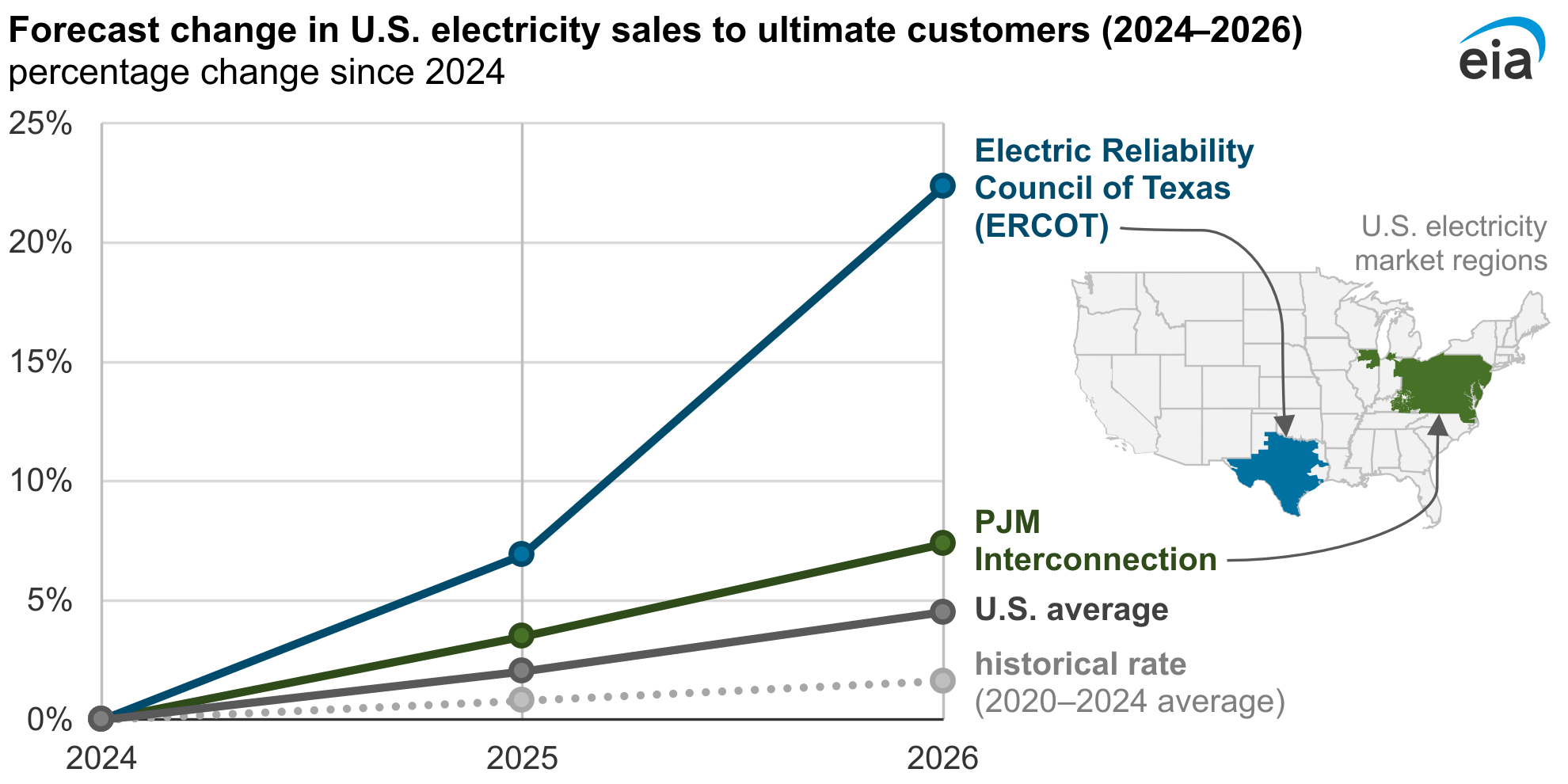
Electricity demand in ERCOT is expected to grow much faster than in most of the country. EIA forecasts electricity sales in the ERCOT region to rise by roughly 22% between 2024 and 2026, compared with about 4–5% nationally.
Much of the pressure comes from a new class of very large electricity users.
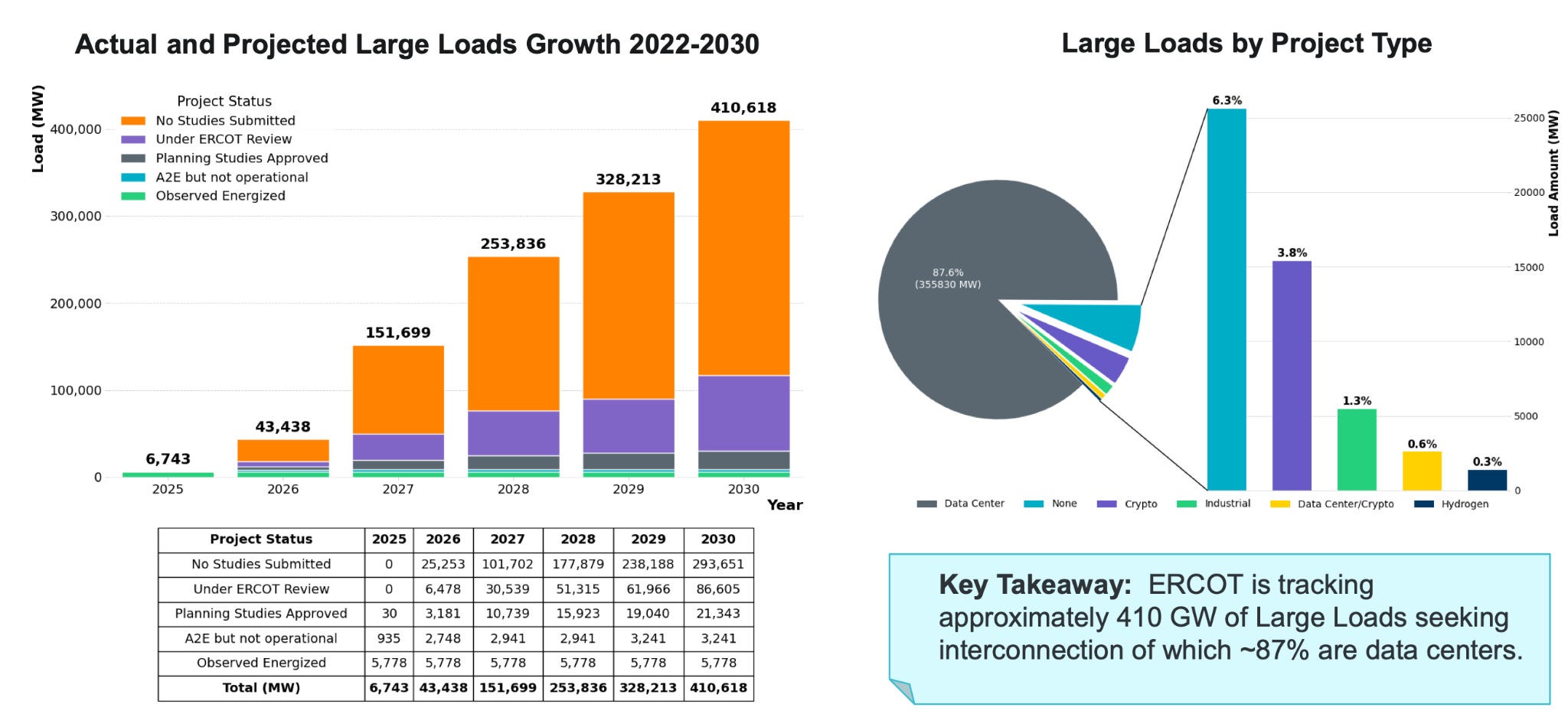
ERCOT is tracking hundreds of gigawatts of proposed large-load projects, and data centers account for the overwhelming majority of that pipeline.
The headline numbers are enormous. But they can also be misleading.
A megawatt in an interconnection request is not the same thing as a megawatt consuming electricity.
Some projects are already energized. Others have planning studies approved. Many remain under review. A significant portion of the longer-term pipeline has not yet submitted studies at all.
That distinction is becoming one of the most important questions in Texas electricity planning.
ERCOT and policymakers have to make decisions about transmission, generation and grid reliability years before they know exactly which projects will reach commercial operation.
Building infrastructure around too little demand creates one set of problems.
Building around load that never materializes creates another.
That helps explain why Texas is asking developers for more evidence about how their projects will actually use the grid.
The state’s questions around peak demand, annual consumption, on-site generation and grid dependence are effectively trying to determine something more useful than a project’s headline MW number:
What will this load actually mean for ERCOT?
And that creates a new problem for the developers themselves.
Power Strategy Starts Before the Meter
For an operating facility, electricity procurement usually begins with something tangible: a meter, historical usage and an existing contract.
A data center under development may have none of those.
Consider a developer planning a 150 MW AI campus in ERCOT. The site may already be under control. Transmission discussions may be underway. An interconnection application may be filed. Capital has been committed and a commercial operation date is on the calendar.
But the facility is not consuming electricity yet.
Its power question is therefore very different from that of an operating commercial building.
It isn’t:
“Are we paying too much for electricity?”
It is:
“How should we economically secure and structure 150 MW of power in ERCOT?”
That question reaches beyond a retail electricity contract.
Where the project is located matters. So does when its load ramps, how consistently it operates, how much supply it expects from the grid, whether it can reduce consumption during constrained periods, and whether generation or storage sits behind the meter.
Two projects can each request 150 MW and create very different economic relationships with ERCOT.
One may operate near full load around the clock and depend almost entirely on the grid.
Another may ramp gradually, maintain on-site BTM generation, install battery storage or have the ability to curtail part of its demand. Introducing the idea of a multi-faceted energy strategy including PPAs, REP funneled power, BTM, storage, etc, all of which depend on clean energy economics.
The engineering requirement may still be expressed in megawatts.
But the economic character of those megawatts is different.
That distinction is becoming increasingly important as Texas evaluates not simply how much electricity a project wants, but how the project intends to source and manage it.
For developers, power strategy can no longer wait until a facility is approaching commercial operation.
It begins while the load still exists on paper.

Moving Power Economics Upstream
That is the problem Polaris is beginning to find success in addressing.
Based in Houston, Polaris has traditionally approached electricity from the operating side of the meter: understanding a company’s load, placing it in ERCOT market context, and using that information to make better procurement decisions.
For a developing data center waiting for interconnection, the starting point has to change.
There may be no historical usage to analyze yet. Instead, Polaris can begin with the characteristics of the project itself: site, expected COD, initial and full-build MW, ramp schedule, load factor, operating profile, grid dependence, curtailment capability, and any planned generation or storage.
Those inputs create what Polaris calls an Economic Power Position.
The objective is not to tell developers how to engineer an interconnection or design a substation. It is to understand what the planned load means economically before hundreds of megawatts are committed to a particular power structure.
A 150 MW project, for example, can be evaluated through several economic scenarios: full grid dependence, partial behind-the-meter generation, storage, or a defined amount of curtailable load.
The question is not simply which architecture is technically possible.
It is how each choice changes the project’s exposure to ERCOT, the forward market, supplier pricing, and ultimately the cost of operating the facility.
That is where Market-Based Procurement becomes relevant.
Rather than waiting until COD approaches and asking suppliers to quote an existing meter, Polaris can bring a future load profile to its procurement network and ask a different question:
How would the market structure supply for this projected load beginning several years from now?
That gives developers earlier visibility into how suppliers are valuing the project, and creates a way to connect development assumptions with actual market economics.
The Market Is Already Pricing the Uncertainty
The challenge is that understanding future demand does not automatically tell a developer what future power will cost.
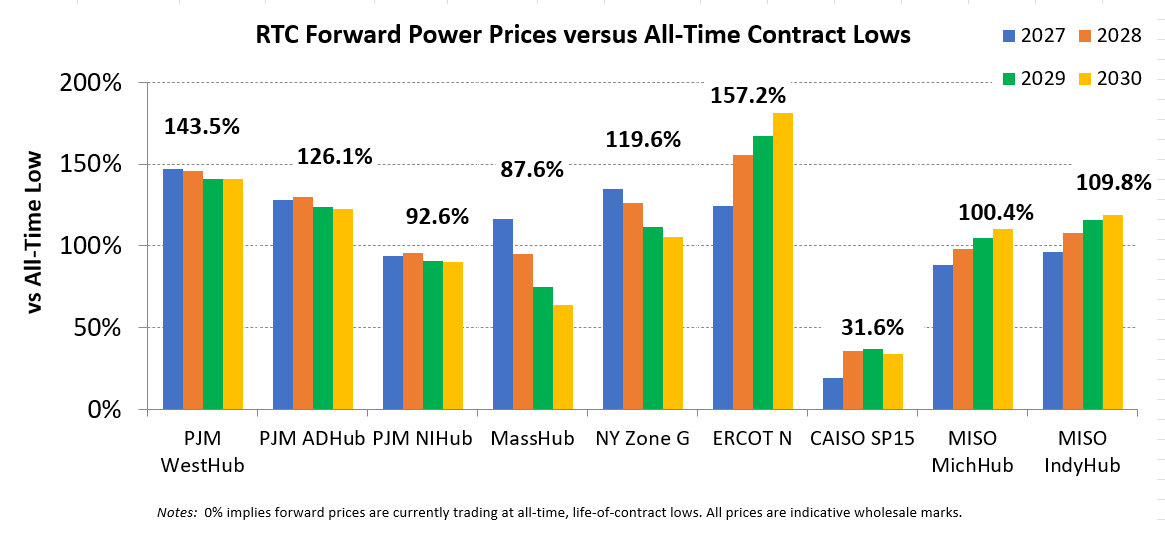
ERCOT’s forward market is constantly repricing expectations about generation, fuel, transmission, weather and load growth. Data centers are now part of that equation, but they are only one part.
Looking at Houston forward electricity prices, the market is not treating every future year the same.
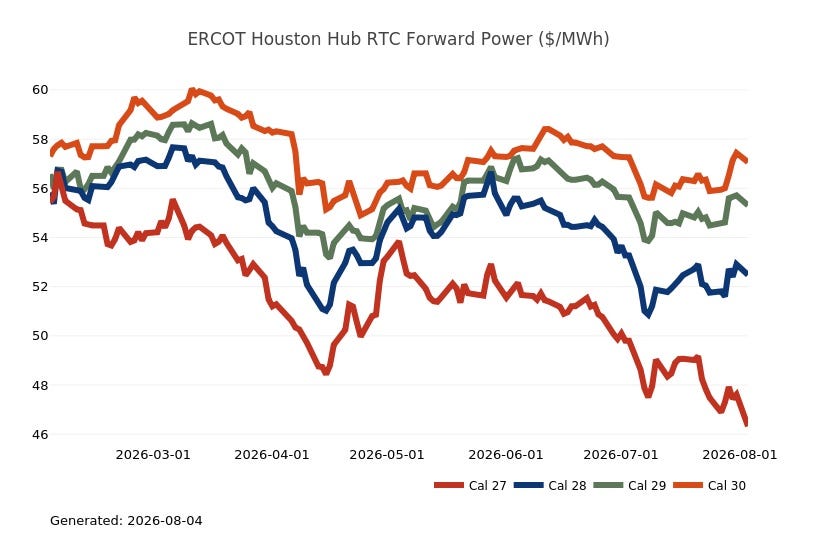
That matters for a project whose COD may still be several years away.
A developer targeting 2028 or 2029 is not buying electricity in a single market called “ERCOT.” It is exposed to a particular location, delivery period, load shape and contract structure, each of which the market can value differently.
And those values move.
A new transmission assumption can change expectations around congestion. Additional generation can soften one part of the curve. Delayed data-center projects can push anticipated demand farther out. New policy requirements can change the economics of how large loads eventually connect.
The practical implication is simple:
Power availability and power economics are related, but they are not the same question.
A project can have a path to interconnection and still make a poor commercial power decision.
That is why Polaris is building visibility into both the project and the market around it.
The Economic Power Position establishes what the future load looks like economically. Market-Based Procurement then connects that position with forward market conditions and competitive supplier structures.
The objective is not to predict ERCOT perfectly.
It is to help the developer understand what the market is offering, what assumptions sit underneath those prices, and how much economic risk the project is taking by acting, or waiting.
Read More From Us

Does renewable generation suppress or amplify Texas power prices?

A short look at one week of ERCOT pricing data, and what it suggests about the tradeoff Texas is making as wind and solar take on a larger share of the grid.
Here’s what NRG's 20% surge in earnings means for Texas Businesses

The largest retail power provider in Texas posted its best Q1 in years, then told investors why the next decade looks even more extreme. Here is what that means for every business buying electricity in Houston.