


Section 1 — The Market Changed
For the last several weeks, I’ve been comparing historical ERCOT hub prices against something entirely different: what has physically changed on the Texas grid since 2022.
At first, the data didn’t make much sense.
Texas has added thousands of megawatts of solar. Battery storage has become a meaningful part of grid operations. Peak electricity demand continues to set new records, and data center development has accelerated into one of the largest sources of projected load growth the market has ever seen.
On paper, those changes suggest a market becoming increasingly constrained over time.
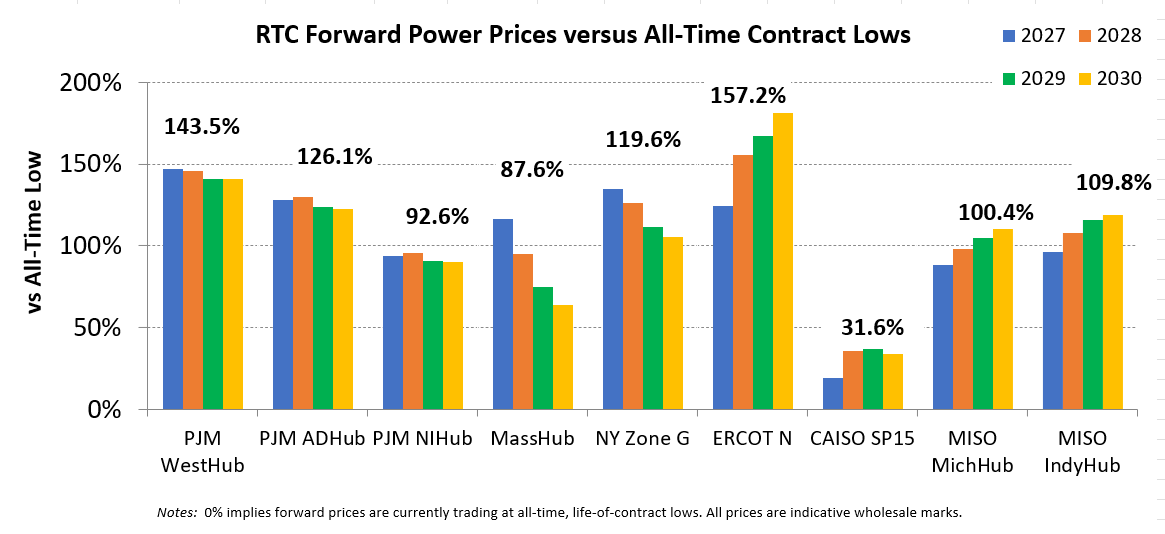
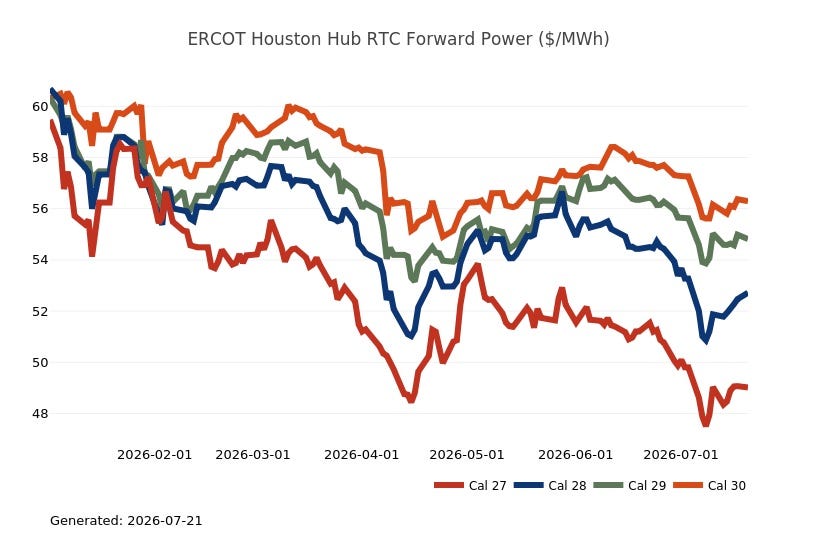
Yet earlier this year, ERCOT forward power contracts were trading near their lowest levels in years.
That isn’t necessarily a contradiction.
It’s a reminder that electricity markets don’t price today’s conditions, they price expectations of the future.
Looking across the forward curve, the market appears to have viewed the rapid growth in renewable generation and storage as sufficient to offset much of the near-term demand pressure. But markets are dynamic. Expectations evolve as new information arrives, and those same forward contracts have already begun moving higher from their lows.
That raises a more interesting question than whether electricity prices are “high” or “low.”
What exactly is the market repricing?
Because once you begin looking beneath the average price, it becomes clear that the Texas electricity market hasn’t simply become cheaper or more expensive.
It’s become structurally different.
Section 2 — The Shape of Electricity Prices Has Changed
One of the more interesting discoveries wasn’t that electricity became cheaper.
It was when electricity became cheaper.
For years, the traditional assumption in ERCOT was straightforward: the afternoon and early evening carried the highest value. That’s when demand was elevated, system flexibility was limited, and suppliers priced the greatest amount of risk.
That relationship has changed.
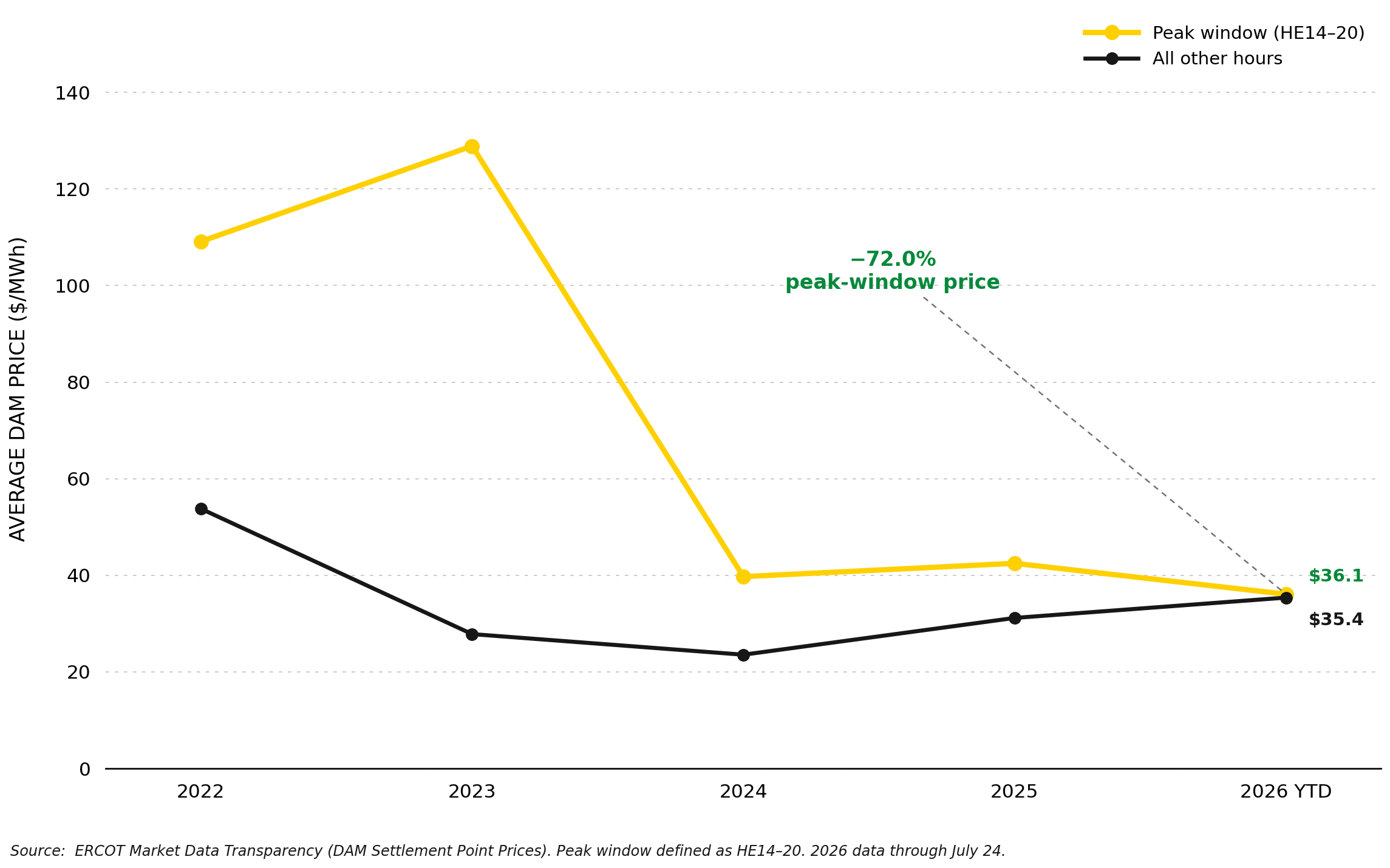
Between 2023 and today, average prices during the historical peak window (HE14–20) have fallen by roughly 72%, while prices during the remaining hours have changed far less dramatically. The result is a market with a much flatter daily pricing profile than it had only a few years ago.
That isn’t happening by accident.
Texas has added thousands of megawatts of utility-scale solar, dramatically increasing electricity supply during the middle of the day. At the same time, battery storage has begun shifting energy into the evening hours, helping reduce some of the price pressure that historically defined the afternoon peak.
The important takeaway isn’t that volatility has disappeared, it hasn’t.
It’s that the market is expressing volatility differently than it did just a few years ago.
Average prices tell us what electricity costs over time.
The shape of prices tells us when the market is under pressure.
For anyone responsible for buying electricity, that distinction matters. Procurement decisions aren’t made against an annual average. They’re made against the hourly risk profile suppliers expect to manage over the life of a contract.
Section 3 — Suppliers Don’t Price Average Electricity
One lesson kept appearing as I compared year after year of ERCOT pricing data.
Average prices tell you what electricity usually costs.
They tell you almost nothing about how risky the market is to serve.
Imagine two years with the same average price.
One reaches that average through relatively stable daily pricing.
The other reaches it because a handful of hours trade hundreds or even thousands of dollars above normal.
From a procurement standpoint, those are entirely different markets.
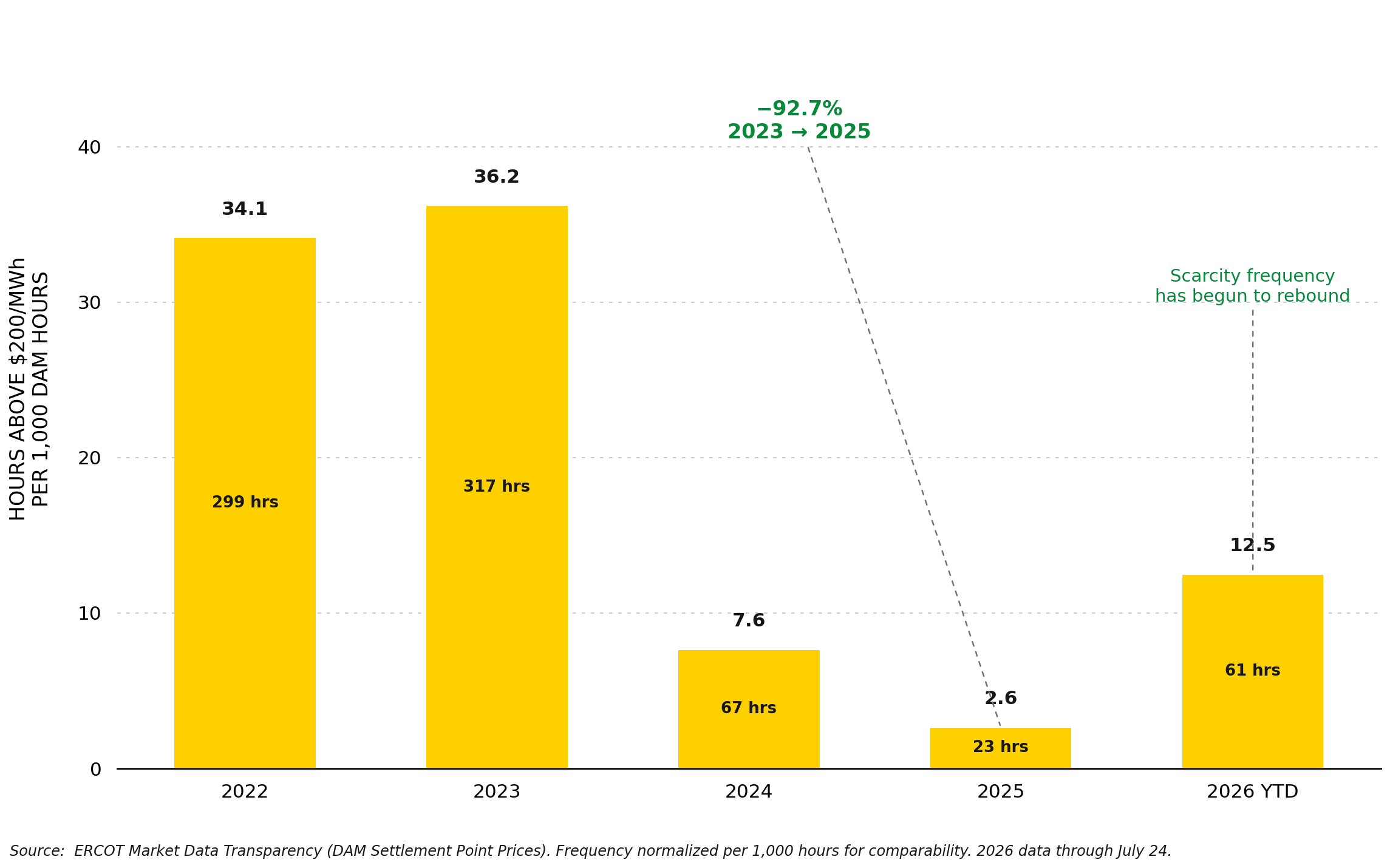
Looking at the frequency of higher-priced hours, the shift becomes much clearer.
Between 2023 and 2025, the number of hours settling above $200/MWh fell by more than 90%. That wasn’t simply a cheaper market, it was a market that experienced far fewer periods of acute stress.
That distinction matters because suppliers don’t hedge an annual average.
They hedge uncertainty.
Every commercial electricity quote reflects an opinion about what the market could do over the next several years. Forward prices are one input. But so are scarcity events, congestion, weather risk, customer load shape, and the probability that those risks occur while a facility is consuming power.
Two businesses can consume the same amount of electricity each year and still receive materially different pricing because they expose a supplier to different types of market risk.
That’s why procurement is rarely just a comparison of cents per kilowatt-hour.
It’s an exercise in understanding how your operation interacts with the market when conditions are no longer average.
Section 4 — Understanding Your Position Before You Go to Market
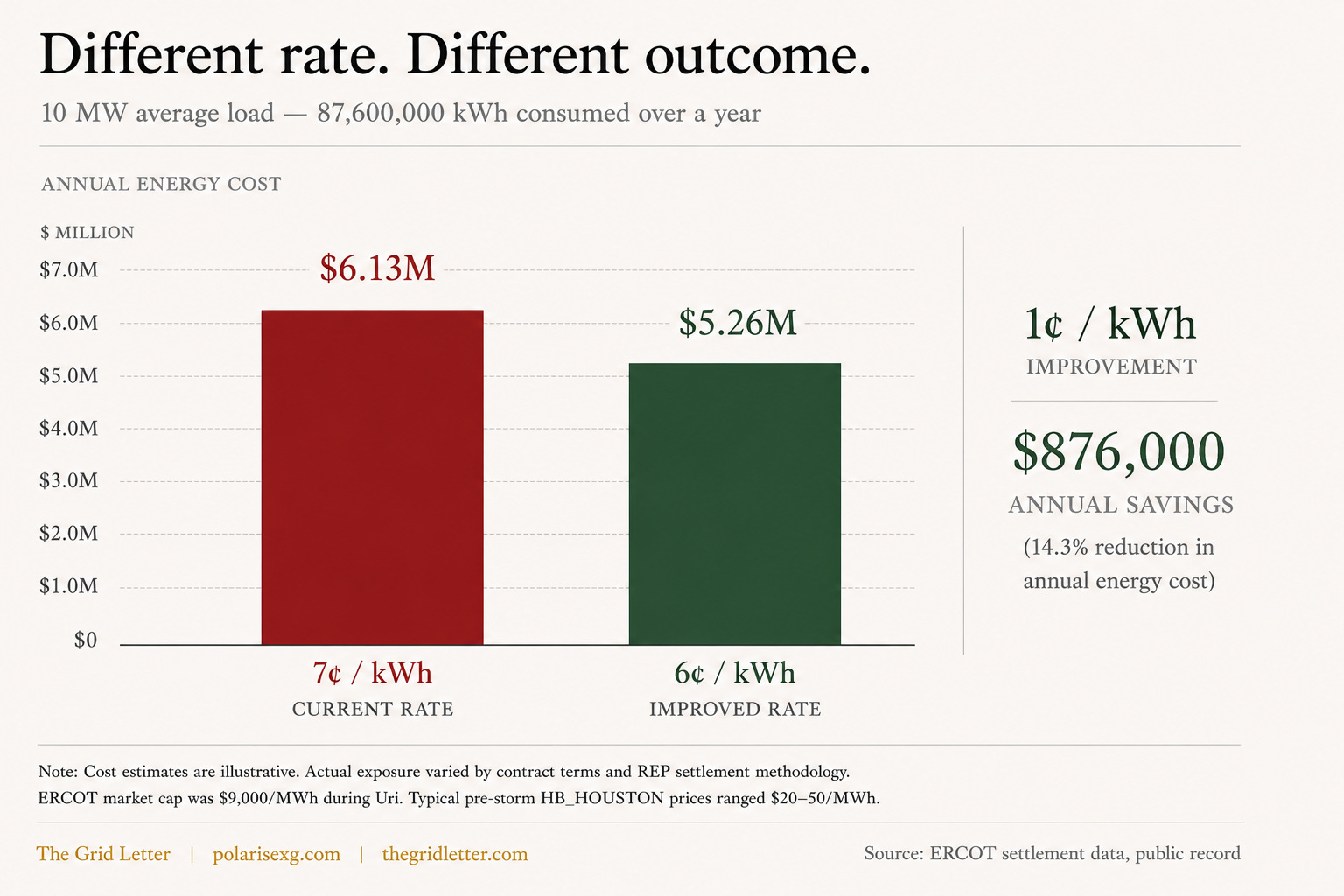
One idea has become increasingly difficult to ignore while studying ERCOT.
Commercial buyers and suppliers often enter the same procurement process with very different levels of market context.
The supplier already understands the forward curve they’re hedging against. They have a view on volatility, expected congestion, weather risk, and how a customer’s historical consumption affects the economics of the contract they’re about to offer.
Most buyers don’t.
They see a quoted electricity rate.
The supplier sees a risk profile.
That difference doesn’t imply suppliers are doing anything wrong. Pricing uncertainty is part of their business. The challenge is that many buyers negotiate without first understanding how their own facility appears from the other side of the table.
That’s the question we’ve been trying to answer at Polaris.
Rather than beginning with supplier quotes, we start by building an Economic Power Report from a facility’s historical interval usage. The objective isn’t to predict the market or identify the “lowest” supplier. It’s to understand how the facility interacts with today’s market structure before procurement begins.
That means asking questions like:
Does this facility consume heavily during the hours suppliers perceive as highest risk?
How consistent is its load profile throughout the year?
How has the market changed since its current contract was signed?
Does today’s forward market create a stronger buying position than the current agreement reflects?
Those questions create context.
And context leads to better procurement decisions.
Sometimes that results in measurable savings.
Sometimes it simply provides confidence that an existing contract remains competitive.
Both outcomes have value because they’re grounded in market understanding rather than assumptions.
Conclusion — The Market You Buy Isn’t the Market You See
When I first started studying ERCOT, I thought procurement was primarily a pricing exercise.
Find the right supplier.
Negotiate the right contract.
Lock in the lowest rate.
The more time I’ve spent studying historical prices, forward markets, and the physical changes occurring across the Texas grid, the less I believe that’s true.
Procurement is ultimately an exercise in understanding where your liquidity (load) sits within a changing market.
Not every business is entering today’s market from the same starting point.
Some companies are renewing contracts signed in 2023, when forward prices reflected a very different set of market expectations.
Others are rolling off agreements negotiated during the elevated pricing environment of 2021 and 2022.
Meanwhile, new facilities are entering the market for the first time, buying electricity under an entirely different set of supply, demand, and forward pricing dynamics.
They’re all purchasing electricity.
They’re just purchasing it from different economic positions.
At the same time, suppliers typically have far more market context than the businesses they’re quoting. They understand forward markets, historical volatility, congestion, load shape, and how each facility’s consumption profile influences the risk they’re assuming. That informational advantage naturally becomes part of every quote they produce.
For buyers, that changes the objective.
The question isn’t simply, “Who has the lowest rate?”
It’s, “What is my position within today’s market, and how does that influence the price of my power consumption?”
That realization has shaped how we’re building Polaris.
Before comparing supplier offers, we believe businesses should first understand their own Economic Power Position, how their historical usage, contract timing, and load characteristics fit into today’s market.
The purpose of an Economic Power Report isn’t to tell a business what decision to make. It’s to provide the market context needed to make that decision with greater confidence.
Because better procurement doesn’t begin with collecting quotes.
It begins with understanding the market you’re entering, and the position you’re entering it from.

Read More From thegridletter

Does renewable generation suppress or amplify Texas power prices?

A short look at one week of ERCOT pricing data, and what it suggests about the tradeoff Texas is making as wind and solar take on a larger share of the grid.
