

Texas Just Changed Again
ERCOT did not simply set another demand record this week.
It moved the ceiling.
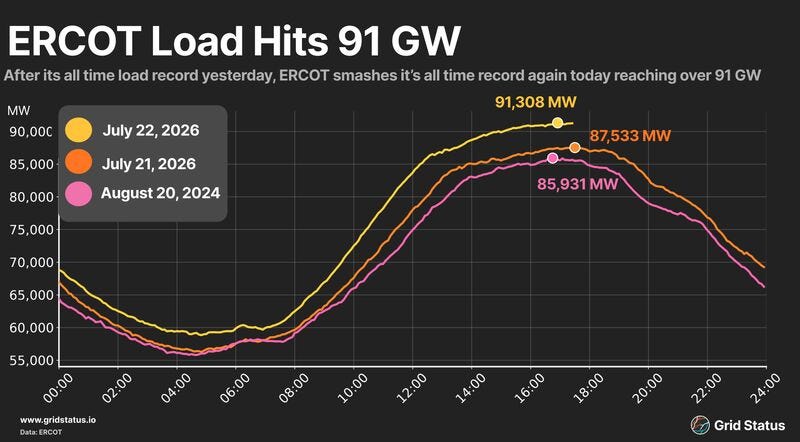
On July 22, instantaneous electricity demand crossed 91 GW for the first time, reaching approximately 91.3 GW. That was more than 5 GW above the record that had existed only two days earlier.
Extreme heat across Texas was a major part of the story. Air-conditioning demand remained elevated across the state’s largest population centers while commercial, industrial, and digital infrastructure continued drawing power throughout the day.
But demand was not the only record being set.
ERCOT also reached new highs for both solar generation and battery discharge, with solar producing approximately 34.6 GW and batteries delivering as much as 11.9 GW back to the grid.
That combination matters.
Texas met record electricity demand with more renewable generation and more stored energy than ever before. The grid absorbed the load. Reliability held. New resources performed a role that would have been difficult to imagine only a few years ago.
And yet, wholesale prices still became sharply elevated later in the day.
That is the tension worth examining.
Texas is adding enormous amounts of solar and battery capacity. Those resources are helping the grid serve unprecedented demand and suppressing prices during periods of abundant production.
But they are not making every hour cheaper.
They are changing which hours are cheap, which hours are expensive, and how quickly the market can move between the two.
A Record Built on More Than Demand
The most important part of the 91 GW record may not be the number itself.
It is the shape of the system behind it.
ERCOT is becoming a grid where record demand, record solar output, record battery discharge, and elevated wholesale prices can all occur within the same day.
Those outcomes are not contradictory.
They are features of a market increasingly shaped by variable generation, fast-changing net load, and large consumers that do not stop operating when the sun goes down.
To understand why prices can remain moderate during one part of the day and rise rapidly only a few hours later, it helps to look beyond total demand.
The more important variable is what remains after renewable generation begins to fall.
That is where the duck curve begins.
The Grid Doesn’t Follow the Sun. Solar Does.
Electricity demand doesn’t disappear when the sun begins to set.
Homes are still cooling.
Factories are still producing.
Hospitals continue operating.
And data centers continue consuming electricity around the clock.
What changes is the supply available to meet that demand.
During the middle of the day, Texas now produces enormous amounts of solar generation. As that electricity enters the grid, it displaces higher-cost generation and increases the overall supply of available power. The result is often lower wholesale prices during daylight hours, particularly in the spring and summer when solar output is strongest.
That has been one of the defining characteristics of ERCOT’s changing generation mix.
But solar follows a predictable schedule.
As the afternoon turns into evening, solar production begins to decline rapidly, even as electricity demand often remains elevated. The grid must replace tens of gigawatts of generation within a relatively short period of time, relying on dispatchable resources such as natural gas, battery storage, imports, and other flexible generation to fill the gap.
That transition is commonly referred to as the duck curve.
It’s less a story about rising demand than it is about rapidly changing supply.
Lower Prices Don’t Necessarily Mean Lower Costs
One of the more interesting consequences of this shift is that renewable generation can both suppress and amplify electricity prices within the same day.
Abundant solar production can create periods of exceptionally low wholesale prices during daylight hours.
As that production fades, prices can rise quickly as the grid replaces those resources with generation capable of responding in real time.
For businesses that operate primarily during daylight hours, those lower-priced periods may provide meaningful economic benefits.
But facilities with continuous electricity demand don’t have that flexibility.
They consume electricity when prices are low.
They also consume it when prices are high.
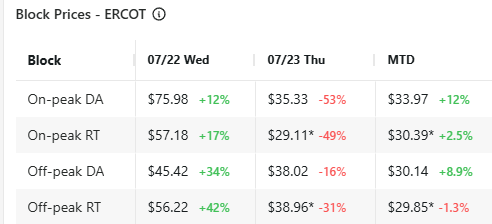
Looking at recent North Hub block pricing, that distinction is becoming increasingly important. While daytime prices continue to benefit from strong renewable production, both on-peak and off-peak pricing have shown upward pressure over time, reflecting a market that is evolving rather than simply becoming cheaper.
For large, continuous-load facilities, the question is no longer whether renewables reduce prices.
The more relevant question is how the changing shape of prices aligns with the way their business consumes electricity.
Data Centers Experience Both Sides of the Duck Curve
Most discussions around the duck curve focus on the grid.
Data centers experience it as an operating cost.
Unlike many commercial facilities, data centers don’t scale their electricity consumption around the availability of renewable generation. Their demand is largely continuous, with servers, cooling systems, and supporting infrastructure operating every hour of every day.
That means they participate in every pricing regime the market produces.
When solar generation is abundant and wholesale prices soften during the afternoon, data centers benefit alongside everyone else.
When solar output falls, net load rises, and more expensive generation is dispatched to meet demand, those same facilities continue consuming electricity through the highest-priced hours of the day.
The economics are fundamentally different from businesses whose operations are concentrated within traditional working hours.
For continuous-load facilities, the shape of electricity prices can become just as important as the average price itself.

A Structural Trend, Not an Isolated Event
That distinction becomes increasingly relevant when looking at where new electricity demand is being built.
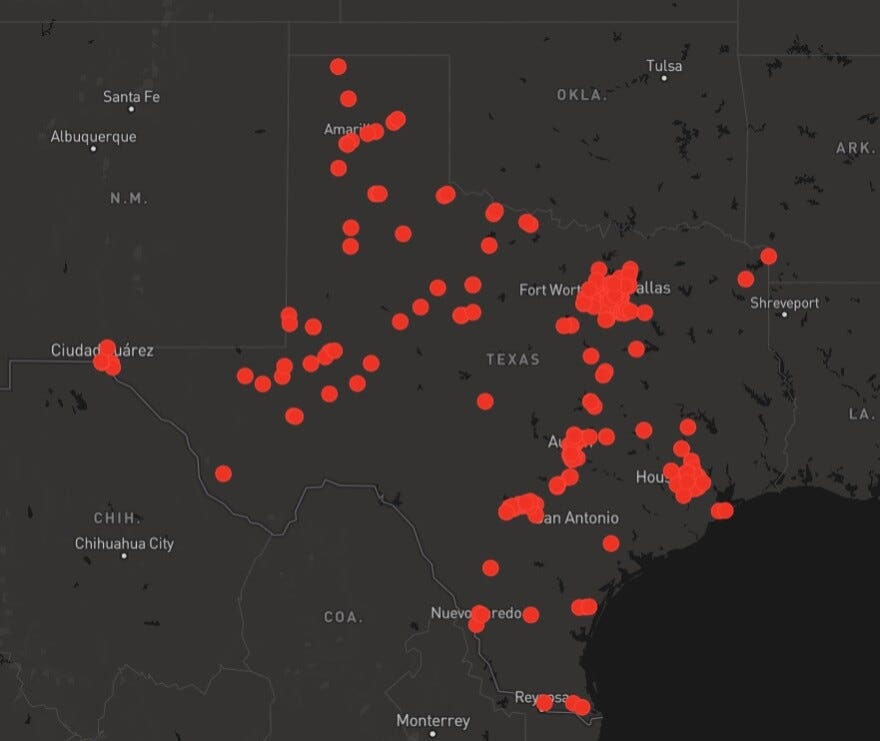
North Texas has emerged as one of the country’s fastest-growing markets for data center development, with a significant concentration of announced projects connecting within the ERCOT North Hub. Similar growth is occurring around Houston and Central Texas, but the Dallas-Fort Worth region has become one of the primary focal points for hyperscale and AI infrastructure.
This isn’t simply adding more demand to the grid.
It’s adding demand that is remarkably consistent.
Unlike many industrial processes or commercial operations, large data centers don’t meaningfully reduce consumption overnight. Their electricity demand remains relatively stable regardless of whether it’s noon or midnight.
As a result, they are exposed to every hour of the market, not just the favorable ones.
That reality is becoming more important as the difference between midday and evening price formation continues to evolve.
The conversation is no longer just about how much electricity a facility consumes.
It’s increasingly about when it consumes it, and how that consumption aligns with the changing behavior of the grid.
If these structural changes are becoming more pronounced, the next question is whether the market recognizes them.
Looking at forward prices, recent block pricing, and the widening spread between Day-Ahead and Real-Time markets, the answer appears to be yes.
The Market Is Already Pricing This Reality
Structural changes to the grid rarely stay confined to engineering discussions.
Eventually, they begin appearing in market prices.
That’s increasingly what we’re seeing across ERCOT.
Looking at recent North Hub pricing, wholesale electricity is no longer simply becoming more expensive, it is becoming more dynamic. Midday prices continue to benefit from abundant solar generation, while evening and overnight hours are exhibiting greater price persistence than many buyers have historically expected.
For facilities operating around the clock, those overnight hours aren’t incidental.
They’re part of the cost structure.
Volatility Doesn’t End When the Sun Sets
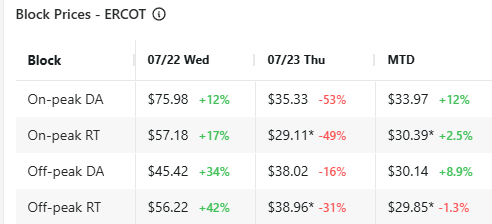
One observation from recent North Hub block pricing is that off-peak electricity prices have remained surprisingly resilient.
Historically, overnight hours often represented some of the least expensive periods of the day. Today, those hours are increasingly influenced by a combination of growing baseload demand, changing renewable output, transmission constraints, and the resources required to balance the system after solar production declines.
For a manufacturing facility that shuts down overnight, that trend may have limited financial significance.
For a data center operating at a consistently high load factor, those hours represent thousands of megawatt-hours of annual consumption.
As the shape of prices changes, so does the value of understanding how a facility’s load profile aligns with the market.
The Difference Between Expectation and Reality
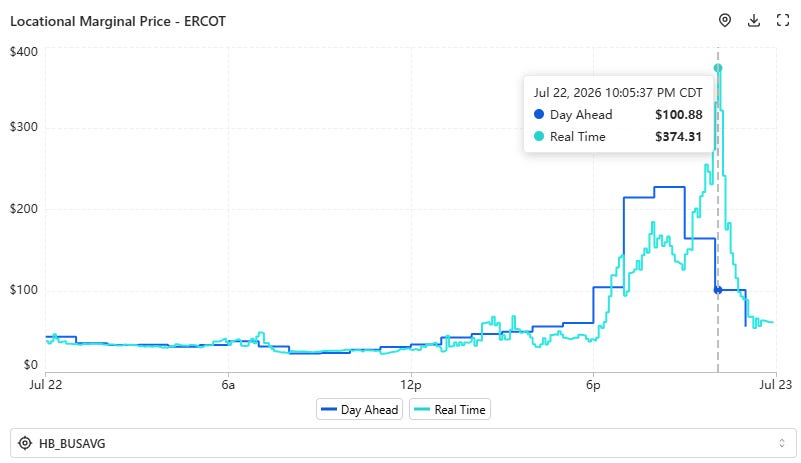
The widening spread between Day-Ahead (DA) and Real-Time (RT) prices tells a related story.
On July 22, Real-Time prices climbed dramatically during the evening ramp, materially exceeding prices established in the Day-Ahead Market only hours earlier.
That spread isn’t necessarily evidence that the Day-Ahead Market is “wrong.”
Rather, it illustrates the challenge of forecasting a system increasingly influenced by rapidly changing renewable output, weather conditions, and real-time operating constraints.
As the grid becomes more dynamic, electricity prices become more responsive to changing conditions.
For buyers, that reinforces an important principle:
Procurement isn’t only about securing a competitive price.
It’s also about understanding how contract structure allocates exposure to those market dynamics.
Some contracts transfer much of that volatility away from the customer.
Others pass portions of that risk directly through.
Understanding the difference is becoming just as important as understanding the quoted rate itself.
Markets Don’t Just Price Today. They Price Expectations.
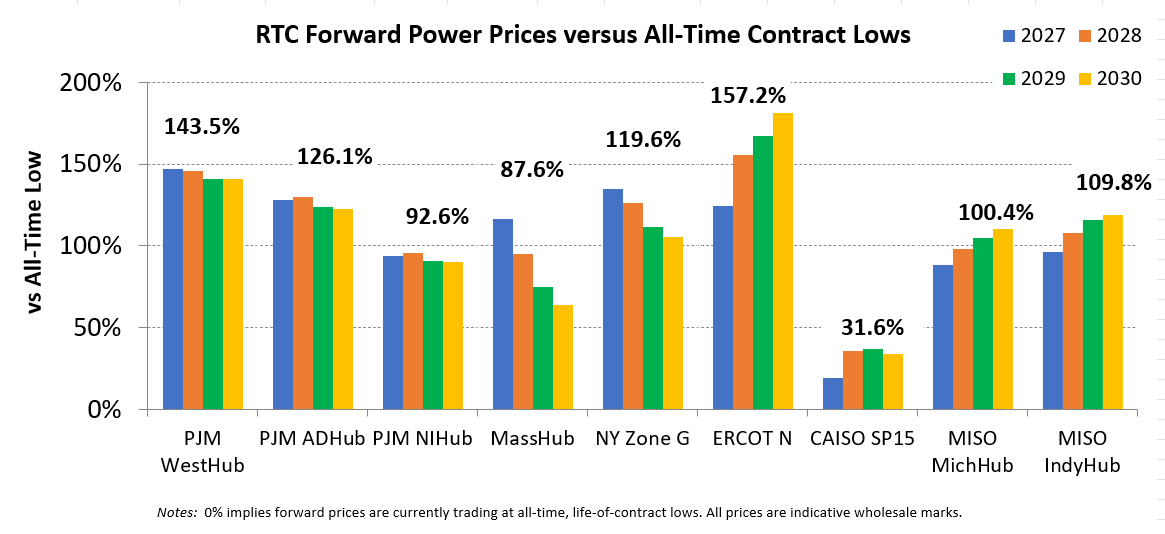
Forward markets provide another perspective.
Unlike spot markets, which reflect current operating conditions, forward prices represent what market participants collectively expect future electricity to cost.
Across the North Hub, forward contracts remain substantially above their historical lows, with some delivery years among the most elevated relative to history of any major U.S. wholesale market.
Forward markets are not predictions.
They’re expectations, constantly adjusting as new information becomes available.
But they do suggest something important:
The market is not behaving as though today’s conditions are temporary.
Participants are assigning value to a future where electricity demand continues to grow, renewable penetration continues to increase, and managing reliability becomes increasingly complex.
For businesses making multi-year procurement decisions, that distinction matters.
The relevant question isn’t whether electricity prices will rise every year.
It’s whether delaying procurement places your business into a market that may become progressively more expensive over time.
The Grid Is Changing. Strategy Should Change With It.
The duck curve is often presented as an engineering problem.
In reality, it’s becoming an economic one.
As renewable generation continues expanding across Texas, the market is becoming increasingly capable of producing two seemingly contradictory outcomes at the same time:
Periods of abundant, low-cost electricity.
Periods of elevated prices and greater volatility.
Neither is inherently good or bad.
They are simply characteristics of a grid whose generation mix is evolving.
For businesses, particularly those operating continuous electrical loads, the implication isn’t that electricity is becoming prohibitively expensive.
It’s that electricity is becoming less uniform.
The value of a kilowatt-hour increasingly depends on when it’s consumed, how it’s purchased, and how exposure to market risk is structured.
That represents a meaningful shift from the procurement environment many organizations became accustomed to over the past decade.
What This Means For Buyers
Markets don’t ask businesses to adapt.
They simply change.
The organizations that consistently achieve better procurement outcomes are rarely those that predict the market perfectly.
They’re the ones that understand the market they’re participating in.
As ERCOT continues adding renewable generation, battery storage, and large flexible loads, buyers should expect electricity markets to become increasingly dynamic rather than simply more expensive.
That changes the questions worth asking during procurement.
Instead of asking only:
“What’s the lowest rate available today?”
Businesses may increasingly benefit from asking:
How does our load profile interact with today’s market?
Which hours create the greatest economic exposure?
Does our contract structure reflect how our facility actually consumes electricity?
What risks are we retaining and which are we transferring?
How should today’s forward market influence procurement timing?
Those questions don’t eliminate uncertainty.
But they can improve the quality of the decisions made within it.
A Final Thought
One of the more interesting aspects of electricity markets is that they don’t care whether participants understand them.
The same forces that shape wholesale prices; weather, generation availability, transmission constraints, demand growth, and market expectations, will influence procurement outcomes regardless.
Our view is simple.
Businesses shouldn’t need to become ERCOT analysts to make informed energy decisions.
They should have access to the context, market intelligence, and analytical tools necessary to understand how those forces affect their own operations.
That’s ultimately why we study these markets.
Not to predict every price movement.
But to help businesses make better decisions in markets that continue to evolve.
About Polaris
The Grid Letter is published by Polaris, an energy intelligence infrastructure platform focused on maximizing cash flow through better power economics for commercial electricity procurement in Texas.
We believe businesses deserve greater visibility into the markets that shape one of their largest operating expenses.
Every article we publish, every analysis we produce, and every assessment we deliver is built around the same objective:
Help businesses better understand the market before they enter it.
If you’d like to see how these market dynamics apply to your own facility, Polaris provides economic power reports built from historical interval usage data, the same information commercial electricity suppliers use to evaluate your business during procurement.
Because better procurement doesn’t begin with better prices.
It begins with a better understanding of your purchasing position.


