

For a commercial facility in Texas, electricity is not an optional expense.
The facility is going to consume power whether the market is favorable or not. The more useful question is how that electricity is sourced and whether the buying process produces an efficient financial outcome for the business.
At scale, small differences matter.
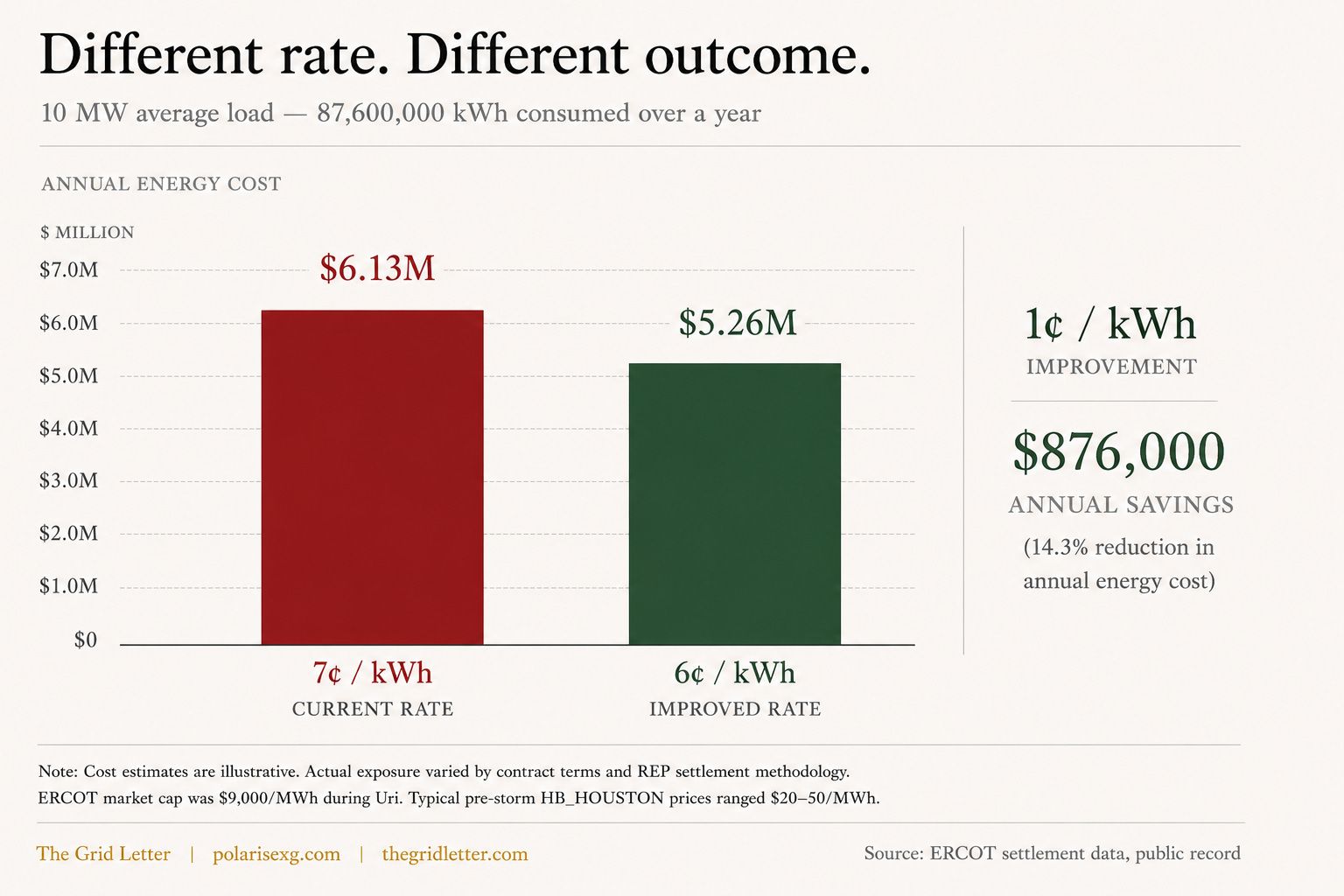
Consider a facility operating at an average load of 10 MW. Over a year, it would consume roughly 87.6 million kWh. At an illustrative rate of 7¢/kWh, that represents about $6.13 million in annual energy cost. At 6¢/kWh, the same consumption represents about $5.26 million.
Nothing about the facility changed.
The difference is the rate at which its demand was priced.
This does not mean every business can simply negotiate one cent off its electricity rate. Commercial electricity pricing does not work that way.
It does illustrate something more important.
The larger a facility’s electricity consumption becomes, the more economically consequential the process used to price that consumption becomes.
Most businesses approach electricity from the perspective of necessity: We need power. What will it cost us?
There is another way to look at the same transaction.
A large facility isn’t only buying electricity. It is bringing millions of kilowatt-hours of recurring demand into a competitive electricity market.
And demand has value.
Understanding that distinction is the starting point for understanding how commercial electricity rates can be sourced more effectively in Texas.
Your Electricity Rate Starts in a Market
If a facility’s demand has value, the next question is: who determines what that demand is worth?
In Texas, there is no single answer.
The commercial rate a business receives sits at the end of a much larger market process. Wholesale electricity prices, the facility’s consumption profile, location, contract term, market timing, supplier risk and margin can all influence the price ultimately offered to the buyer.
That matters because the market underneath those offers is constantly moving.
Looking at average Q1 Day-Ahead Market prices in Houston, that movement has become increasingly visible. Average prices rose from roughly $26/MWh in Q1 2024 to $32/MWh in Q1 2025 and $39/MWh in Q1 2026.
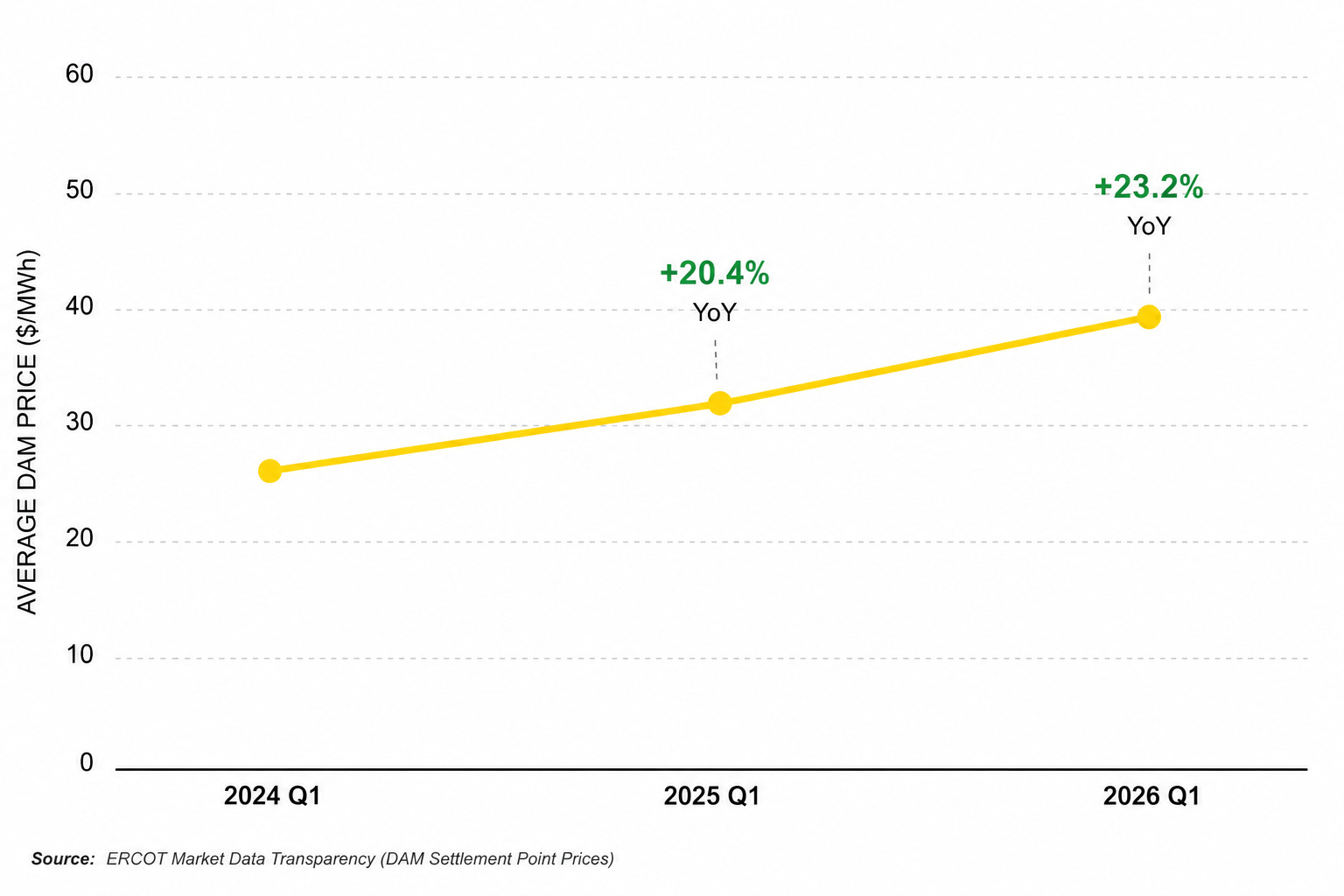
Three years of Q1 pricing do not, by themselves, prove that electricity prices will continue rising. Weather, generation availability, fuel costs, renewable output, transmission conditions and demand can all change the market from one period to another.
But the progression illustrates the problem with treating an electricity rate as a static number.
The supplier quoting a commercial facility must price the obligation to serve that load against the market conditions surrounding it. As those conditions change, so does the economics of serving the customer.
This creates an important distinction.
A commercial buyer sees a rate.
The market sees a load that must be served over time.
That load has a location, shape, operating pattern and risk profile. Suppliers can value those characteristics differently, which means the price available to a facility is not necessarily one universally agreed-upon number.
And that is where the buyer’s position becomes interesting.
Because if multiple suppliers can place different values on the same demand, the objective is no longer simply to ask a supplier for its price.
It is to understand the market well enough to make suppliers compete to price the demand.
There Is No Single Texas Electricity Price
This is where commercial electricity procurement becomes more nuanced.
It is tempting to think of the power market as having a prevailing price: electricity is either expensive or inexpensive, and the buyer’s job is to wait for the right moment to purchase.
But electricity is not priced that simply.
The market assigns different values to power depending on where it will be delivered, when it will be consumed and how far into the future that delivery occurs.
Looking at Houston Hub forward prices during 2026 makes the distinction clear.
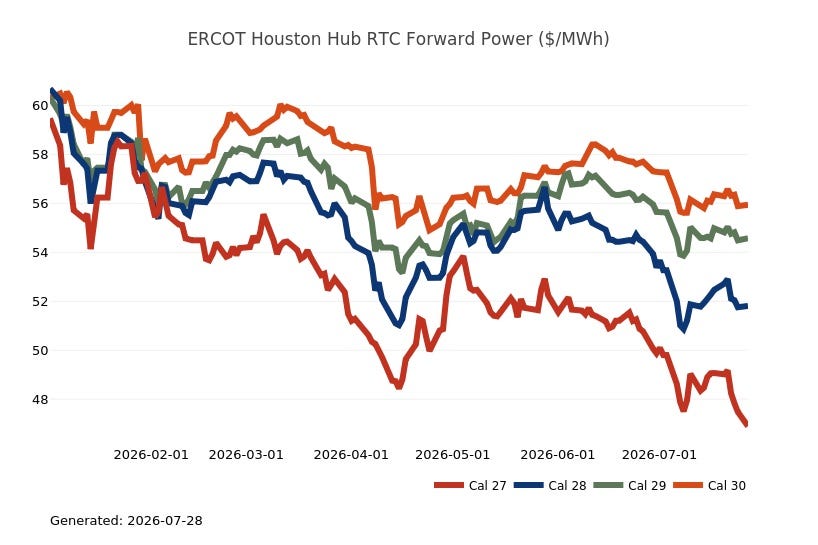
By late July, the market was pricing Cal-27 near $47/MWh while Cal-30 remained around $56/MWh. Earlier in the year, those same contracts had traded much closer together.
The important point isn’t whether $47 or $56 represents a “good” price.
It is that both prices existed in the same market at the same time.
A facility entering a one-year agreement, a three-year agreement and a five-year agreement is exposing itself to different parts of the forward market. Change the location, load profile or timing of the transaction, and the economics can change again.
This is why asking whether Texas electricity prices are currently “high” or “low” has limited usefulness for a commercial buyer.
A better question is:
What is the market currently offering for the electricity our facility actually needs to buy?
Price alone also doesn’t tell the entire story.
Periods of extreme market tightness can influence supplier risk even when average electricity prices appear relatively manageable. ERCOT’s recent scarcity history makes that distinction useful.
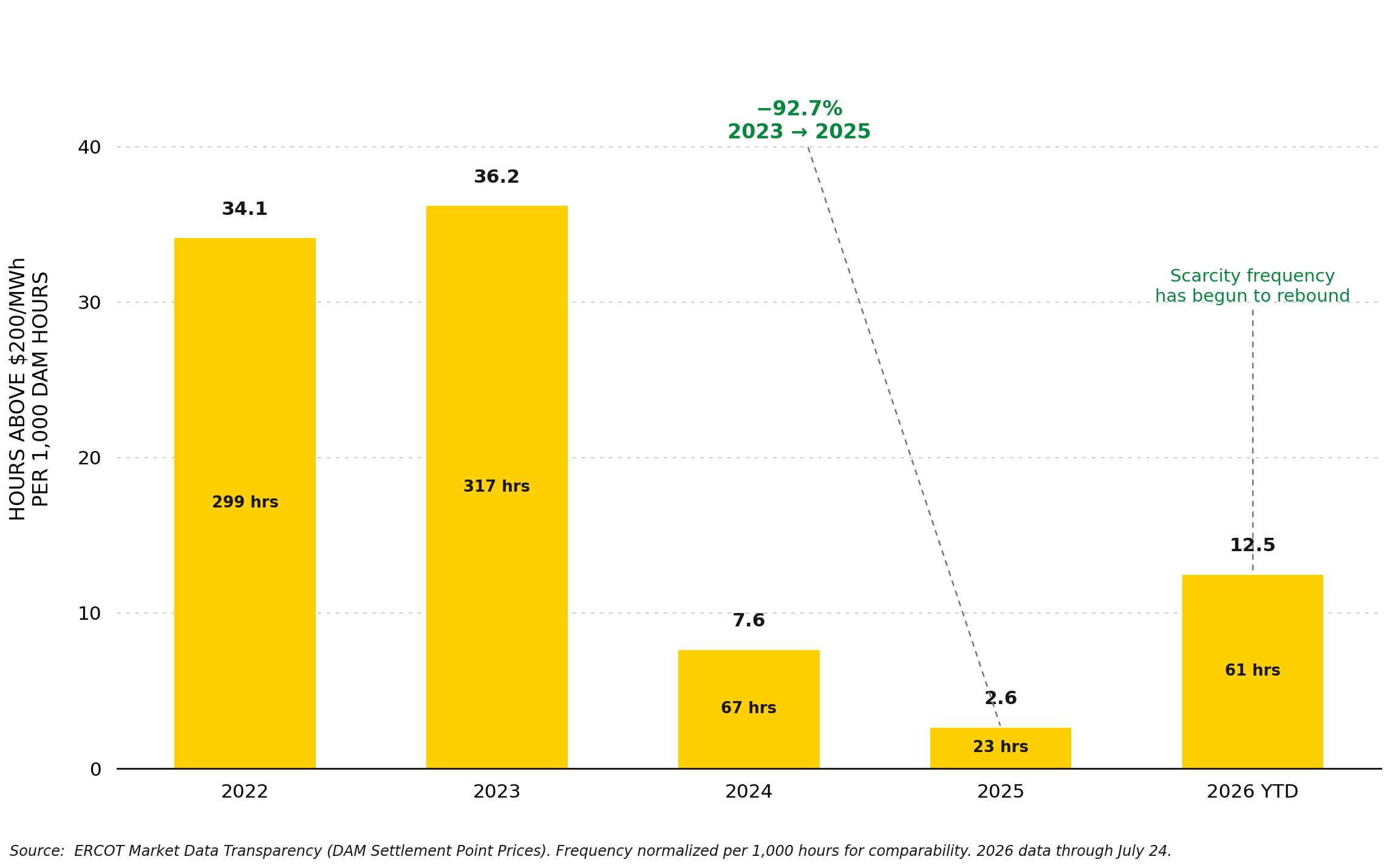
Scarcity frequency fell dramatically from 2023 through 2025 before increasing again in 2026 year to date. That does not tell us where scarcity will go next. It does show why a procurement decision cannot be reduced to a single average market price.
Suppliers are pricing an obligation to serve electricity in a market whose value changes across time, location and risk.
Commercial buyers are purchasing that same obligation from the other side.
Once you understand that, sourcing a lower rate becomes less about finding a supplier with a cheaper number and more about understanding where your specific demand fits inside the market.
And that brings us back to the facility itself.
Your Load Has Economic Value
Once electricity is viewed as a market transaction rather than simply a utility expense, the role of the facility begins to look different.
Every commercial facility brings demand to the market. For larger consumers, that demand can represent tens or hundreds of millions of kilowatt-hours over the life of a contract.
Suppliers want the opportunity to serve that load.
But not every megawatt of demand looks the same.
Consider two facilities that consume the same amount of electricity annually. One operates continuously with relatively predictable consumption. The other experiences large peaks, seasonal swings and irregular operating hours.
Their annual usage may be identical, but the economics of serving them can be very different.
A facility’s load shape, load factor, peak demand, operating schedule, location and seasonality all help determine how its consumption interacts with the market. Contract length, product structure, credit and timing add another layer.
This is why simply knowing how much electricity a facility consumes isn’t enough.
The more useful question is how that consumption is positioned.
We call this a facility’s Economic Power Position: the relationship between its electricity demand, the market conditions surrounding that demand, and the commercial terms available to serve it.
This changes the way procurement can be approached.
Instead of beginning with:
“Which supplier can give us a lower rate?”
A buyer can begin with:
“What does our load look like, how is the market likely to value it, and how can we create competition around that demand?”
That distinction matters in a deregulated market.
Suppliers already compete for commercial load. Each has its own portfolio, hedging position, risk tolerance, cost structure and commercial objectives. As a result, two qualified suppliers evaluating the same facility do not necessarily have to arrive at the same price or contract structure.
The buyer’s opportunity is to make that competition work in its favor.
Not by trying to predict every movement in ERCOT.
Not by becoming a power trader.
And not simply by negotiating harder against a single quote.
The objective is to bring an understood block of demand to an informed group of suppliers and allow the market to compete for it.
The supplier has supply.
The facility has demand.
Both sides bring something economically valuable to the transaction.
The procurement process should reflect that.
How to Put Your Demand to Work
Understanding a facility’s Economic Power Position is useful only if it changes how electricity is sourced.
The conventional procurement process often starts near the end: a contract is approaching expiration, the business requests pricing, a supplier provides a rate, and negotiations begin.
A market-based approach starts earlier, with the facility itself.
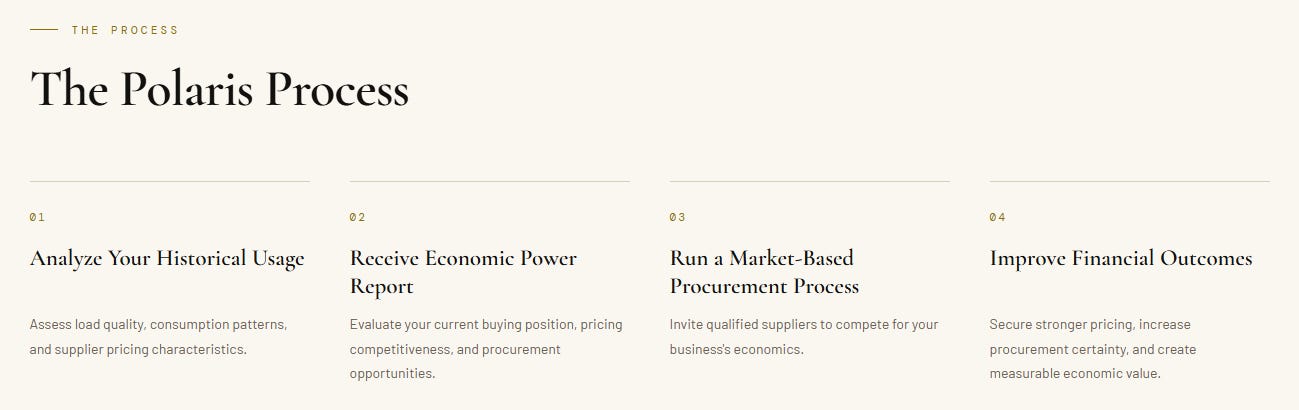
The framework is relatively straightforward.
1. Analyze the load.
Start with the facility’s historical electricity data. Ideally, this includes at least 12–24 months of interval and billing information. The objective is not simply to calculate annual usage, but to understand when and how the facility consumes power.
2. Establish the buying position.
Compare those load characteristics with current and forward market conditions. This connects what the facility needs to buy with the market available to serve it.
3. Determine the procurement strategy.
Contract term, product structure, timing and risk tolerance should reflect the business behind the meter. A manufacturer operating continuously may have different priorities from a facility with seasonal or highly variable demand.
4. Create competition for the demand.
Present the same structured opportunity to multiple qualified suppliers. Instead of negotiating against one supplier’s view of the market, the buyer can observe how several suppliers independently value the same load.
This is where the process becomes powerful.
If one supplier values the load differently because of its portfolio, hedging position, risk appetite or commercial objectives, competition gives the buyer an opportunity to discover that difference.
5. Evaluate the outcome.
The lowest headline rate is not automatically the best contract. Price matters, but so do contractual terms, risk allocation, pass-through provisions and how well the product fits the facility’s operating profile.
The objective is not simply to collect more quotes.
It is to create a market for your demand.
And none of these principles are exclusive to Polaris. A commercial electricity buyer can build this process internally, work through an advisor, or develop its own supplier relationships.
Polaris applies the same framework through its internal analytics, market intelligence and supplier network. The advantage of that infrastructure is execution: taking raw facility data, determining its Economic Power Position, and running a structured sourcing process across suppliers including NRG, Constellation and ENGIE.
The methodology itself is simpler:
Understand the load. Understand the market. Then make the market compete for the load.
Read More From Us


Here’s what NRG's 20% surge in earnings means for Texas Businesses

The largest retail power provider in Texas posted its best Q1 in years, then told investors why the next decade looks even more extreme. Here is what that means for every business buying electricity in Houston.