


Why Texas Electricity Prices Spike Every Summer (And What It Costs Businesses Who Wait)
Every summer, Texas businesses feel a spike they could have seen coming in April.
The bill arrives. The number is higher. The reaction is the same: frustration, a quick Google search, maybe a call to the provider. By then, the market has already moved. The price you are reacting to was set weeks before you felt it.
This is not bad luck. It is a pattern. And patterns can be anticipated.
What the Data Actually Shows About Texas Electricity Rates
Texas electricity demand is not growing gradually. It is accelerating. Data centers, industrial expansion, and population growth are stacking on top of each other at a pace the grid was not built to absorb. By 2032, total power demand in ERCOT could reach four times what it is today, driven largely by AI infrastructure and large-scale industrial load.
That matters to your business for one specific reason: data centers are price-insensitive buyers. They need power regardless of cost. When they compete for supply during tight conditions, they win. You pay the difference.
The market has already shown what that looks like under pressure. Between 2021 and 2023, wholesale electricity prices in Texas rose over 200%. That was not a fluke. It was the system behaving exactly as designed under stress.
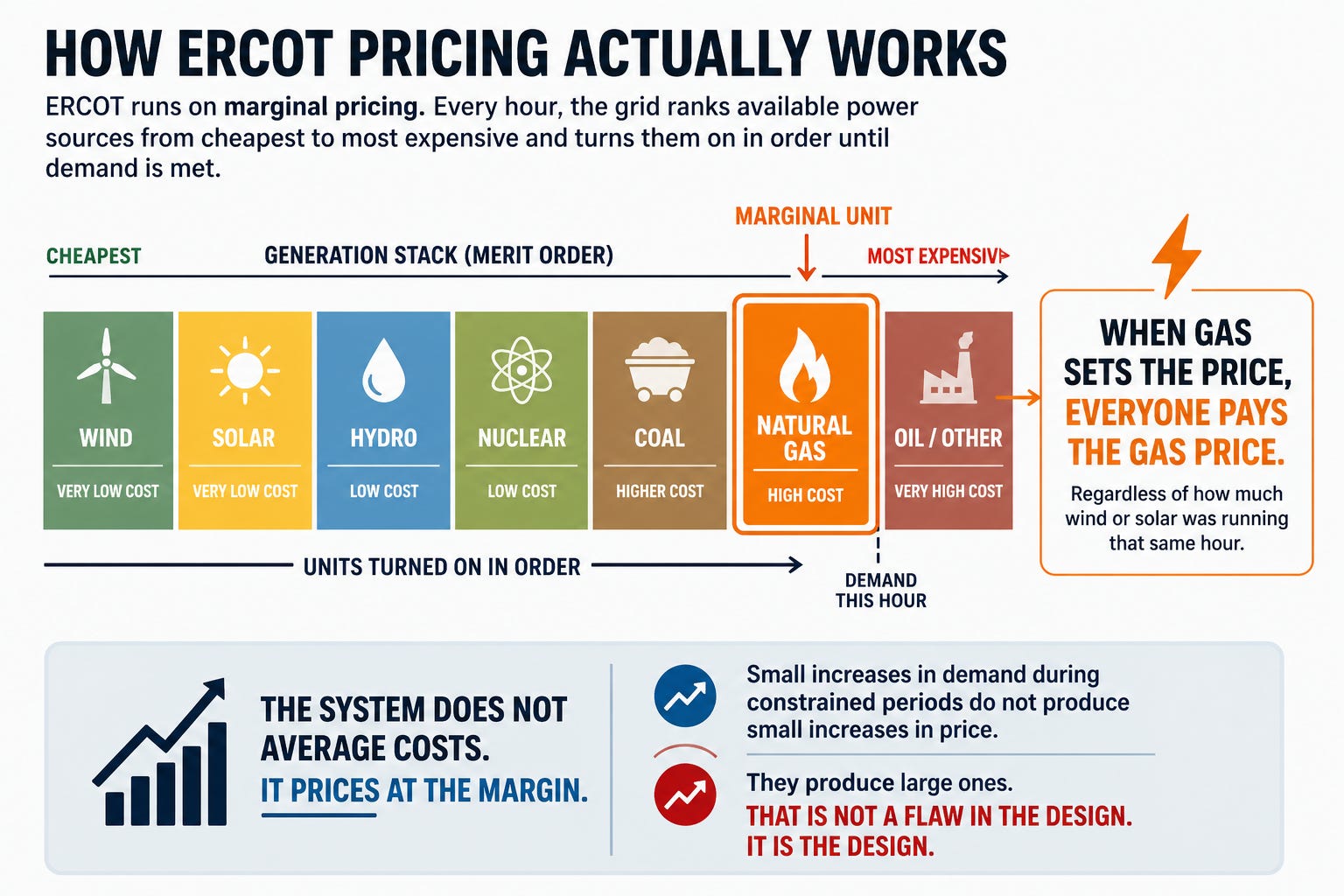
Here is how the pricing mechanism actually works, plainly stated. ERCOT runs on marginal pricing. Every hour, the grid lines up available power sources from cheapest to most expensive and turns them on in order until demand is met. Whatever the last, most expensive unit costs sets the price for everyone on the grid that hour. During normal conditions, that last unit is relatively cheap. During high demand periods, when cheaper sources are already maxed out, natural gas generation steps in as the marginal source. Natural gas is expensive. When it sets the price, everybody pays a gas price for electricity, regardless of how much wind or solar was running that same hour.
The system does not average costs. It prices at the margin. Small increases in demand during constrained periods do not produce small increases in price. They produce large ones. That is not a flaw in the design. It is the design.
Why Texas Electricity Price Increases Are Structural, Not Seasonal
Think about every essential resource a modern society runs on. Water. Gas. Oil. Electricity. Every one of them faces the same pressure: demand compounds as society scales, but the infrastructure supporting supply moves slowly. What you are seeing in Texas electricity prices is not a regional quirk. It is that universal dynamic playing out in one of the fastest-growing markets in the country, accelerating faster than most people realize.
Texas is not just adding residents. It is adding data centers, manufacturing plants, and industrial operations that consume electricity at a scale no single household ever could. These are not price-sensitive buyers who reduce consumption when costs rise. They are locked-in, always-on loads that the grid has to serve regardless of conditions. Grid infrastructure to support that demand will not be fully in place until the 2030s. The gap between what the market needs and what the system can deliver is where prices live right now.
This is the part most business owners miss. They think of electricity as a utility cost that fluctuates seasonally, the way fuel prices do, something that goes up in summer and comes back down. That mental model is outdated. The underlying market has structurally shifted. Wholesale prices that spiked over 200% between 2021 and 2023 did not fully retreat. The floor moved up. Each new demand layer, each new data center, each new industrial connection raises the baseline that future prices are built on top of.
There is a useful parallel in how the internet changed commercial real estate. Before widespread adoption, location was the primary cost driver for businesses. After, bandwidth and connectivity became non-negotiable operating costs that repriced everything around them. Electricity in Texas is undergoing the same transition. It is moving from a background utility to a strategic input that directly determines margin. The businesses that recognize that transition now will make fundamentally different decisions than the ones that figure it out after the next spike.
The System Working Against Uninformed Business Electricity Buyers
Here is what the system does not advertise.
Suppliers in the Texas electricity market build their pricing around one assumption: that most buyers are not paying attention. When your contract comes up for renewal, the default path is the easiest one. You renew, you move on, you absorb whatever rate the market is offering at that moment. The supplier knows this. They price accordingly.
What most business owners never see is the spread between what they paid and what a competitive process would have produced. Without running the market, you never know how many suppliers would have competed for your account, or what that competition would have driven the price down to. The quote you accepted was not necessarily the best available. It was simply the one in front of you.
Beyond the rate itself, there are cost layers most businesses have never been shown:
Transmission and delivery charges have been rising steadily since 2021, independent of energy prices. These are system costs, infrastructure costs, the price of moving electricity from where it is generated to where you consume it. They flow directly into your bill whether energy markets are calm or volatile.
The 4CP mechanism. Four Coincident Peaks. During the four highest demand hours on the ERCOT grid each summer, your facility’s consumption is measured and used to calculate a portion of your transmission costs for the following year. Most businesses have never heard of it. The ones who have structured their operations around it pay materially less than the ones who have not.
The system is not designed to be opaque. It is simply optimized for participants who understand it. Every supplier, every retailer, every large industrial buyer is running their own calculation, hedging their own risk, optimizing their own outcome. The business owner who auto-renews without running a competitive process is the only player at the table who is not playing the game. That is not a moral failing. It is an information gap. And information gaps in this market have a direct dollar cost.
Why Late May Through June Is the Highest-Risk Window for Texas Business Electricity Rates
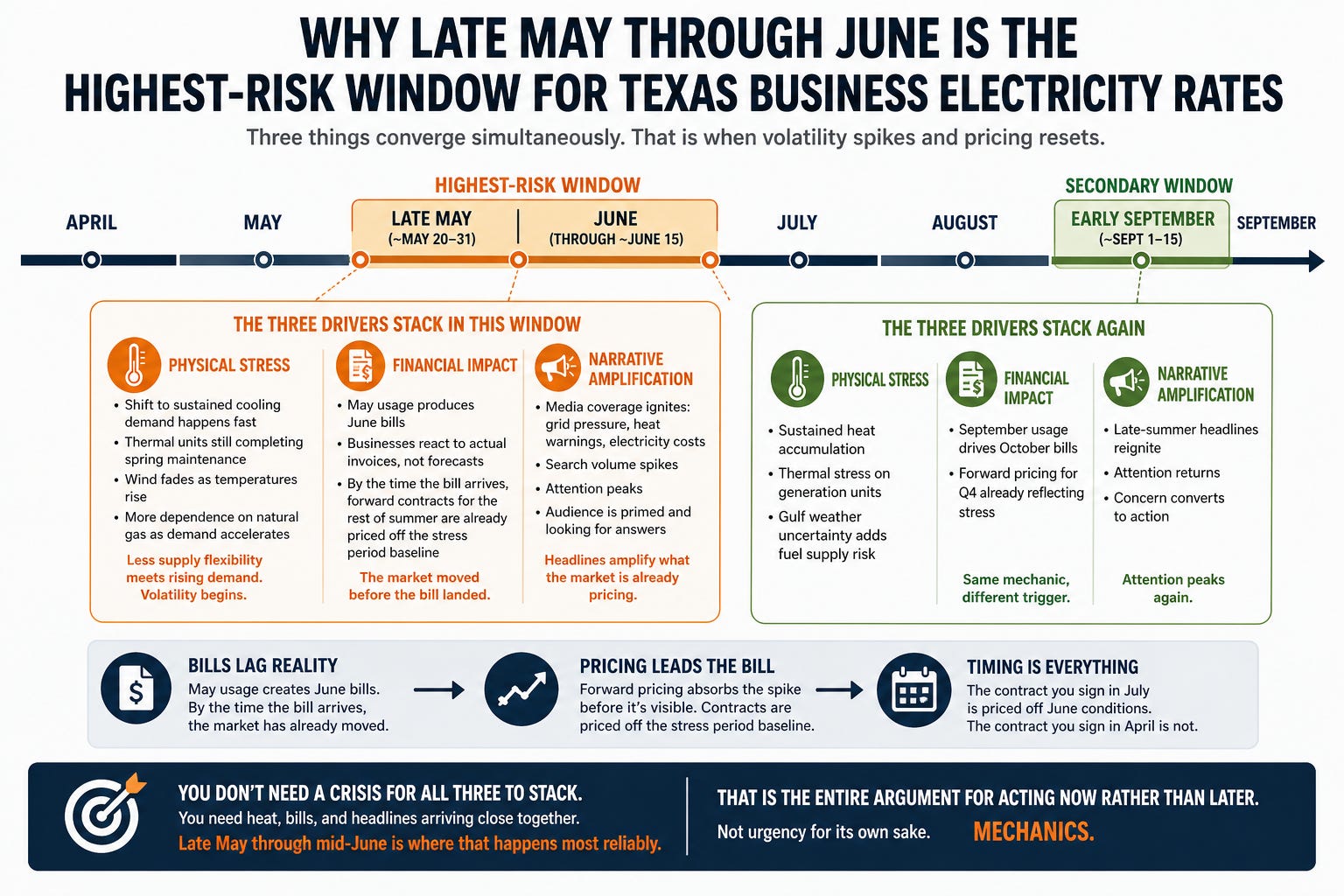
The late May to mid-June window is not a forecast. It is where three things converge simultaneously every year.
Physical stress. Texas shifts from mild seasonal load to sustained cooling demand faster than the grid can fully adjust. Thermal generation units are still completing spring maintenance cycles. Wind output, strong through spring, fades precisely when temperatures begin to climb. The grid becomes more dependent on natural gas at the exact moment demand starts accelerating. Less supply flexibility meeting rising demand is where volatility begins.
Financial impact. May usage produces June bills. Businesses do not react to market forecasts. They react to actual numbers on actual invoices. By the time the bill arrives reflecting elevated May and June rates, forward contracts for the remaining summer are already priced off the stress period baseline. The market moved before the bill landed.
Narrative amplification. Early summer is when media coverage ignites. Headlines about grid pressure, heat warnings, and electricity costs reach people who were not paying attention to market mechanics. Search volume spikes. Attention peaks. The audience is primed and looking for answers.
You do not need a crisis for all three to stack. You need heat, bills, and headlines arriving close together. Late May through mid-June is where that happens most reliably.
A secondary window opens in early September, driven by sustained heat accumulation, thermal stress on generation units, and Gulf weather uncertainty adding fuel supply risk. Different trigger, same outcome.
By the time the spike is obvious, forward pricing has already absorbed it. The contract you sign in July is priced off June conditions. The contract you sign in April is not.
That is the entire argument for acting now rather than later. Not urgency for its own sake. Mechanics.
What Getting Ahead of Texas Electricity Costs Actually Looks Like
None of this requires you to become an energy analyst.
It requires three things. Know what you are currently paying per kilowatt hour and what structure your contract is in, fixed or variable. Know when your contract expires. Know what your peak usage looks like heading into summer, because that determines your exposure before the window opens.
That is the entire checklist. Businesses that have those three answers are already ahead of the majority of commercial buyers in this market. Most are operating on autopilot, renewing without running a competitive process, unaware of the transmission cost layer, and completely unfamiliar with how their summer consumption patterns affect what they will pay next year.
You do not have to predict the future to position ahead of it. You just have to understand the pattern well enough to move before it repeats. The market will do what it always does. The only variable is whether you are in front of it or behind it when it does.
Free Commercial Electricity Audit — No Commitment
If you own or operate a commercial facility in Texas, here is what a no-cost rate audit covers:
Your current rate structure, fixed vs. variable, and what it exposes you to this summer
A competitive market analysis across available suppliers for your account
Your 4CP exposure and what it means for next year’s transmission costs
Contract timing recommendations based on current forward pricing
No obligation. No pressure. A clear picture of where you stand before the window opens
Initial Audits Are Complimentary - Sign Up Here
If this was useful, forward it to a business owner whose electricity bill you think about. One conversation before summer could be worth real money.