

Commercial Electricity Procurement Has Quietly Changed
Commercial electricity procurement used to be a relatively straightforward exercise.
A business would approach contract renewal, request pricing from several suppliers, compare proposals, and select the offer that best aligned with its objectives.
That process still exists.
What has changed is everything happening behind the scenes.
Texas is entering a period of sustained electricity demand growth, driven largely by data centers, industrial expansion, and electrification. At the same time, renewable generation is reshaping when electricity is abundant, when it becomes scarce, and how wholesale prices form throughout the day.
As those market dynamics become more complex, so too does the process of pricing commercial electricity.
Suppliers aren’t simply responding to higher demand.
They’re adapting to a market whose behavior is fundamentally different than it was only a few years ago.
For buyers, that raises an important question.
If the market has changed, should procurement change with it?
The Market Suppliers Price Today Isn’t the Market They Priced Yesterday
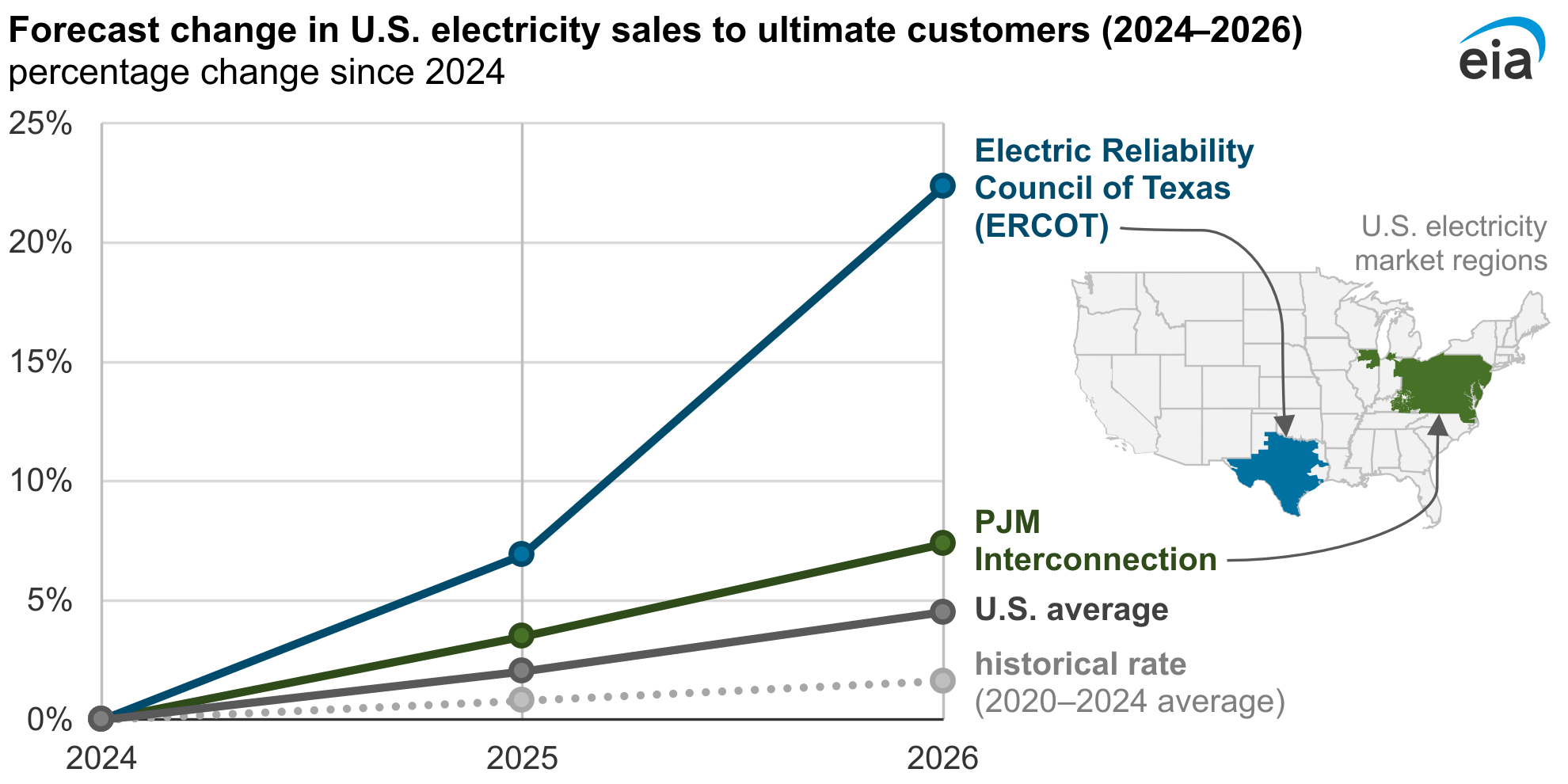
The U.S. Energy Information Administration expects ERCOT to experience the strongest electricity demand growth of any major power market through 2026.
Much of that growth is expected to come from large, continuous electrical loads, particularly data centers.
At the same time, ERCOT continues adding significant amounts of renewable generation and battery storage, changing not only the amount of electricity available, but also the way prices form throughout the day.
Those changes don’t automatically make electricity more expensive.
Nor do they automatically make procurement more difficult.
They do mean suppliers are evaluating facilities within a market that behaves differently than it did in previous procurement cycles.
That context matters.
Because before a supplier ever produces pricing, they first have to understand how your facility fits into today’s market, not the market of five years ago.
A Different Market Demands a Different Level of Analysis
Demand growth is only part of the story.
The more meaningful change is where that demand is coming from.
For decades, electricity demand followed relatively familiar patterns. Residential consumption rose in the evenings. Commercial buildings were busiest during the day. Industrial facilities often operated on predictable production schedules.
Today’s growth looks different.
Much of ERCOT’s projected demand is coming from facilities that consume enormous amounts of electricity around the clock. Data centers, particularly those supporting AI workloads and cloud infrastructure, don’t slow down when the workday ends. Their demand remains remarkably consistent, regardless of the hour, the weather, or the day of the week.
Looking at ERCOT’s interconnection pipeline, that trend becomes difficult to ignore. The overwhelming majority of proposed large-load projects are data centers, representing hundreds of gigawatts of potential demand over the coming years.
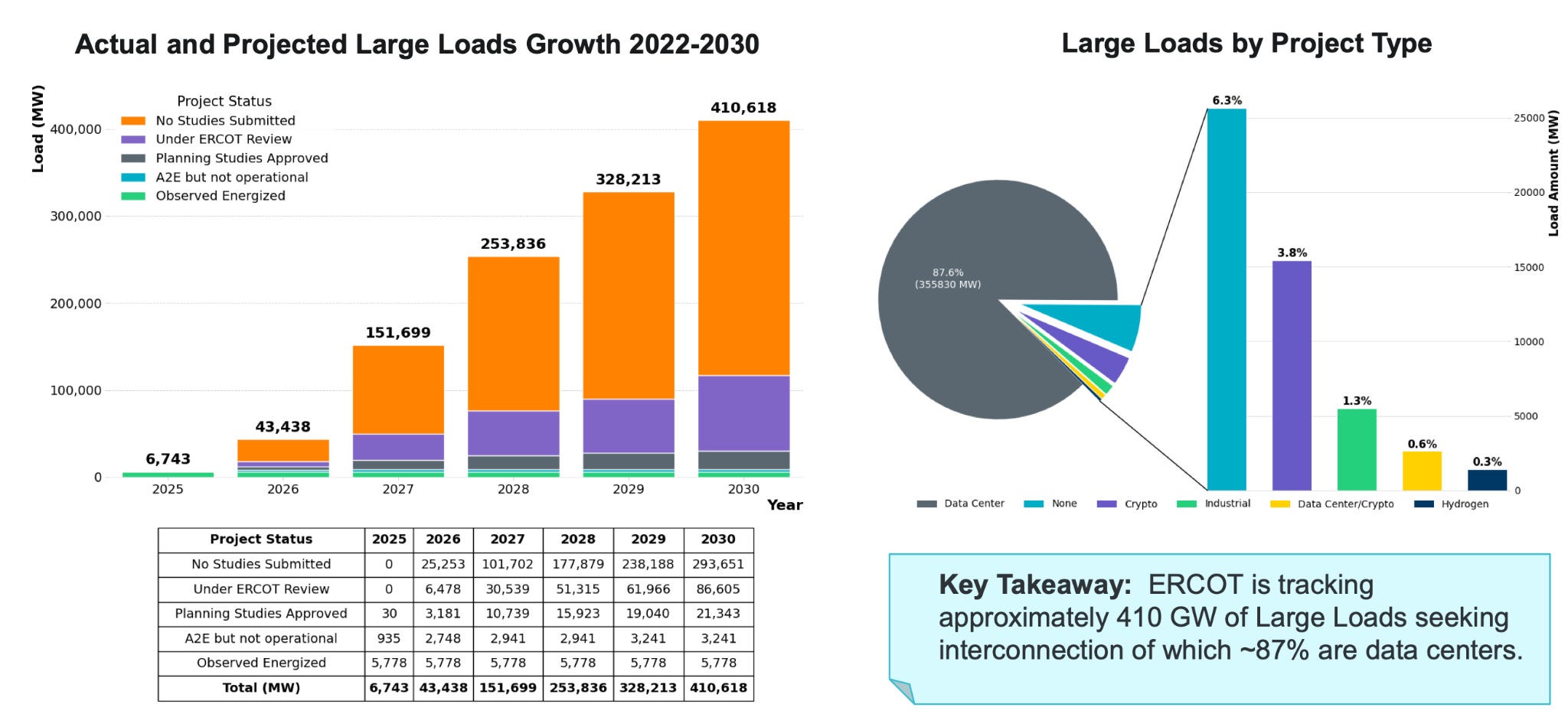
This doesn’t mean all of that capacity will ultimately connect to the grid.
It does, however, illustrate where both developers and market participants expect future electricity demand to concentrate.
For suppliers, that changes the nature of procurement.
Pricing a continuously operating 50 MW data center is fundamentally different from pricing an office building or a manufacturing facility that shuts down overnight. The market conditions that matter, the risks that must be evaluated, and the contract structures that make sense all become more nuanced.
As the composition of demand changes, supplier analysis naturally becomes more sophisticated.
Not because suppliers have changed.
Because the market they’re pricing has.
Markets Price Expectations, Not Just Today’s Conditions
The same idea begins to appear when looking beyond physical demand and into forward electricity markets.
Forward prices aren’t forecasts. They’re financial instruments reflecting what market participants collectively believe future electricity will be worth under current information.
Across major U.S. wholesale markets, ERCOT North continues to trade among the highest relative to its historical contract lows. That doesn’t guarantee higher future prices, but it does suggest that participants are assigning meaningful value to future supply-demand uncertainty.
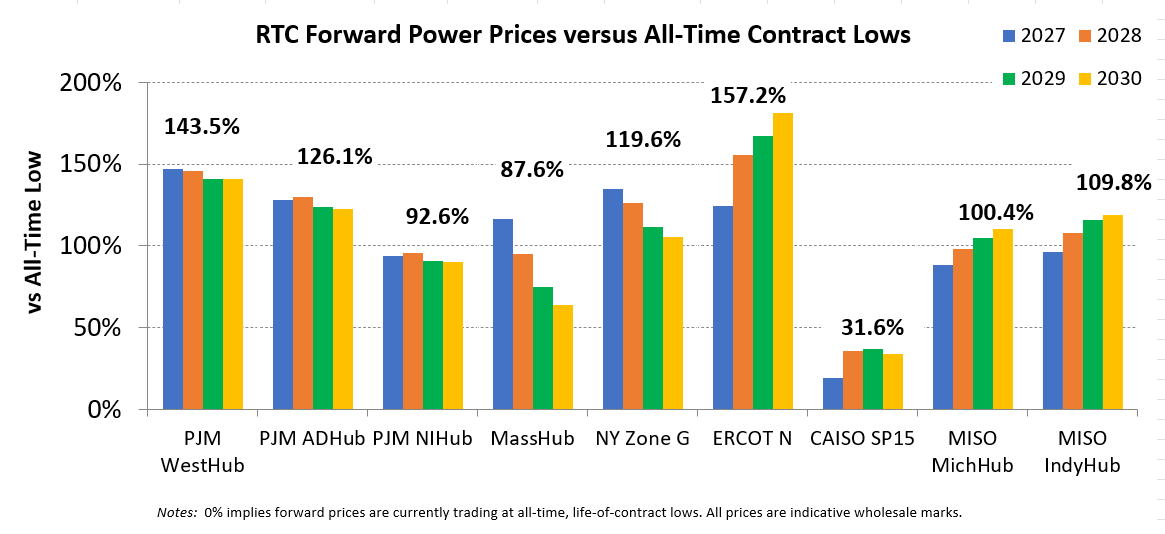
For businesses planning facilities with operating lives measured in decades rather than years, those expectations matter.
Procurement decisions are no longer being made against a static backdrop.
They’re being made within a market that is continuously repricing future risk as new generation, new demand, transmission constraints, and policy changes reshape the system.
That raises another question.
If suppliers are evaluating both where the market is heading and how an individual facility behaves within that market, what exactly are they looking for before they ever produce a quote?
Every Facility Has a Different Economic Power Position
Two data centers can consume exactly the same amount of electricity each year and receive meaningfully different procurement outcomes.
On paper, they might appear nearly identical.
Each operates around the clock.
Each consumes tens of megawatts.
Each requires long-term price certainty.
Yet suppliers rarely evaluate facilities using annual consumption alone.
Because annual consumption tells you how much electricity a business uses.
It tells you very little about how that electricity is consumed.
That distinction becomes increasingly important in a market where price formation is evolving.
As renewable generation continues reshaping wholesale electricity markets, the economics of a facility are no longer determined solely by the volume of electricity it purchases. They’re increasingly influenced by when electricity is consumed, how consistently demand behaves, and how those consumption patterns interact with the market itself.
In other words, two facilities purchasing the same number of kilowatt-hours may present very different procurement opportunities.
Beyond Consumption
This is why suppliers request historical interval data before producing a quote.
They’re not simply confirming annual usage.
They’re building a picture of how a facility behaves.
Questions they’re attempting to answer include:
Is demand relatively consistent throughout the day or highly variable?
How exposed is the facility to the hours where prices tend to become more volatile?
Does the operational profile align well with today’s market structure?
Which contract structures are likely to produce the most competitive long-term outcome?
Those questions aren’t designed to make procurement more complicated.
They’re designed to reduce uncertainty.
Because in commercial electricity markets, suppliers don’t simply price electricity.
They price the uncertainty of delivering it.
Markets Evolve. So Do The Characteristics That Matter.
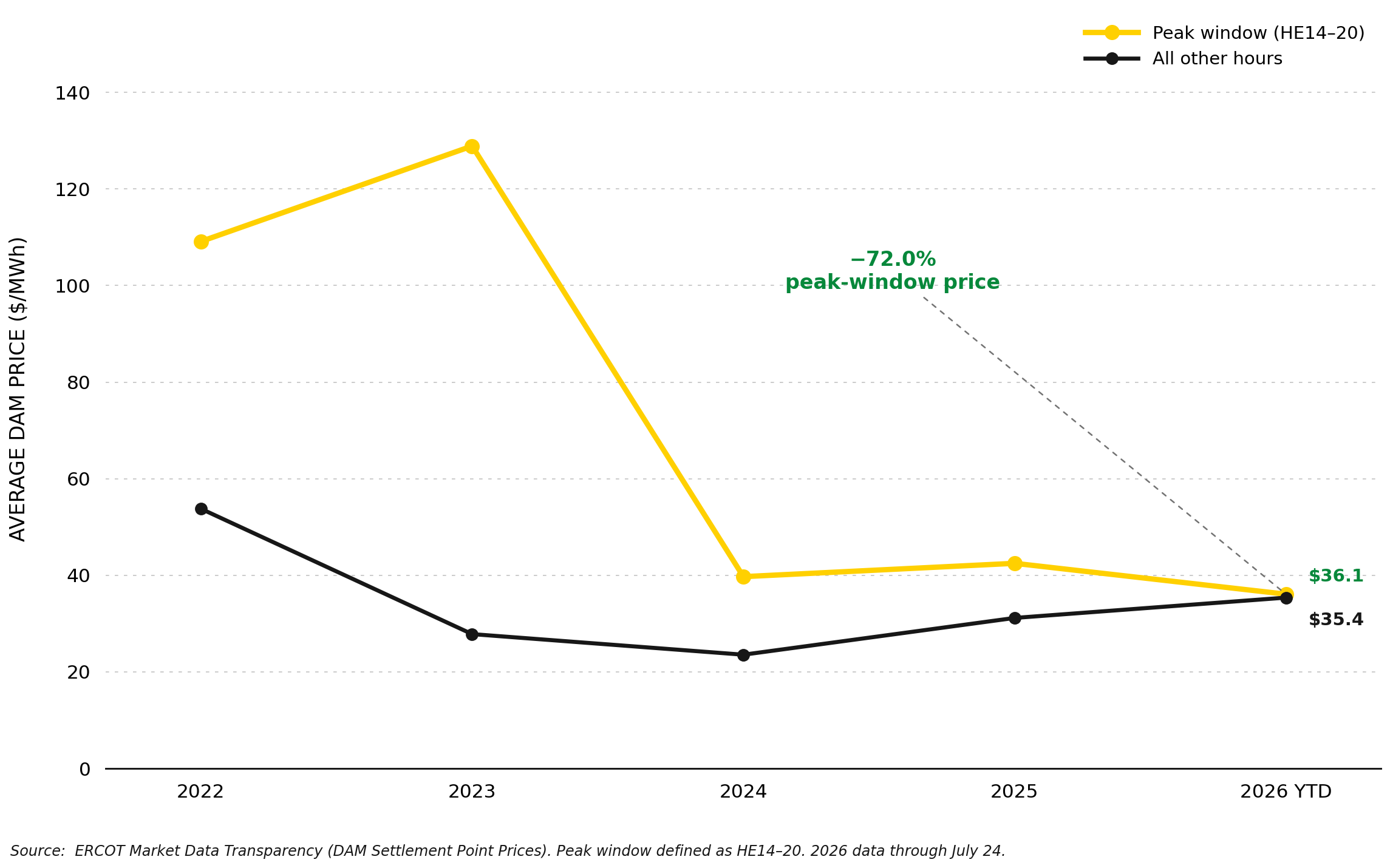
Looking at Houston Hub pricing over the past several years, a notable pattern begins to emerge.
The traditional distinction between expensive daytime hours and inexpensive overnight hours has narrowed considerably. Peak-hour prices have compressed, while off-peak prices have gradually moved closer to those daytime averages.
That doesn’t mean volatility has disappeared.
It means the market is expressing risk differently than it once did.
The implication for buyers is subtle but important.
A procurement strategy built around yesterday’s pricing behavior may not fully reflect today’s market dynamics.
As the shape of prices changes, understanding how a facility’s operating profile aligns with that shape becomes increasingly valuable.
It’s no longer sufficient to ask, “What rate can we get?”
A more useful question may be:
“How does today’s market evaluate the way our facility consumes electricity?”
That question sits at the center of modern commercial electricity procurement.
It’s also the question that led us to develop what we call an Economic Power Position a framework for understanding how market conditions and facility characteristics come together before procurement ever begins.
Understanding Your Economic Power Position
Every facility enters the electricity market differently.
Some of those differences are operational. Others are structural. Many are shaped by market conditions entirely outside the buyer’s control.
Together, they form what we refer to as a facility’s Economic Power Position.
An Economic Power Position isn’t a single metric or score. It is a framework for understanding how the electricity market interacts with the way a facility consumes power, and how that relationship ultimately influences procurement economics.
It brings together two sides of the same transaction.
The market:
Forward prices.
Congestion.
Scarcity and volatility.
Generation mix.
Regional price behavior.
And the facility:
Load profile.
Operating schedule.
Consumption consistency.
Peak exposure.
Location.
Contract objectives.
Neither side tells the full story on its own.
A favorable market does not necessarily mean every facility will receive favorable pricing. And an attractive load profile does not eliminate the influence of timing, location, or broader market conditions.
The economics emerge where the two intersect.
That intersection is your Economic Power Position, and understanding it gives you a clearer view of how the market may value your load, where procurement leverage exists, and what competitive power should reasonably cost before you begin asking suppliers for prices.
Markets Change. So Does Your Position.
One of the most important ideas in commercial electricity procurement is that a facility’s buying position is never truly fixed.
The facility may not change.
Its operating schedule may remain consistent. Its load profile may look nearly identical year after year. Its annual consumption may stay within the same range.
But the market surrounding that facility is constantly moving.
Consider the forces we’ve explored throughout this article.
Demand is growing.
Large continuous-load facilities are becoming a greater share of ERCOT’s future load.
Renewable generation is reshaping when electricity is abundant, and when it isn’t.
Forward markets are continuously repricing expectations for future power.
Peak and off-peak pricing relationships are evolving.
Congestion patterns shift as generation, transmission, and demand change across the grid.
None of these changes originate from the facility itself.
Yet each can alter the economic environment in which that facility buys power.
That means the same data center, consuming electricity in essentially the same way, can hold a very different Economic Power Position from one procurement cycle to the next.
A load profile that was relatively expensive to serve under one set of market conditions may become more attractive under another. A contract structure that made sense three years ago may no longer reflect the economics available today.
This is why procurement should not begin with a simple question:
“What rate can we get?”
It should begin with a more fundamental one:
“How is our facility positioned in today’s market?”
Because the market moves.
And your Economic Power Position moves with it.

Context Creates Better Decisions
Take two identical 40 MW data centers.
Place one in North Texas.
The other near Houston.
Their annual consumption may be nearly identical.
Their operations may be nearly identical.
Even their procurement objectives may be the same.
Yet they participate in different regional pricing dynamics, experience different congestion patterns, and interact with different local market conditions.
The objective isn’t to determine which facility is “better.”
It’s to understand the context each facility operates within before procurement begins.
That’s ultimately what an Economic Power Position seeks to provide.
Not certainty.
Context.
Because procurement decisions become more effective when they’re informed by both how your facility operates and the market it’s operating within.
The Economic Power Report
That thinking ultimately led us to develop the Economic Power Report.
Not because electricity buyers needed another report.
But because we believed they should have access to the same kind of market context suppliers use when deciding how to price their load.
The Economic Power Report is built around a simple question:
How does today’s electricity market view your facility?
Rather than looking only at what a facility has historically paid for electricity, the report examines the relationship between how the facility consumes power and the market in which that power is being purchased.
It brings together:
Historical interval usage.
Load shape and consumption consistency.
Current and forward market conditions.
Regional pricing dynamics.
Peak and off-peak exposure.
Procurement and contract considerations.
And ultimately, the facility’s Economic Power Position.
The result is an independent view of how the facility is positioned before supplier pricing enters the conversation, what characteristics may strengthen or weaken its buying position, where procurement leverage may exist, and what competitive power should reasonably cost under current market conditions.
The objective is not to predict where electricity prices will move next.
It is to give buyers enough market context to make a more informed procurement decision before committing millions of dollars to a power contract.
From there, the intelligence can be used in either direction:
Take the report to market independently, or use Polaris to run the competitive procurement process on your behalf.
Either way, the principle is the same:
Understand your position before you negotiate from it.
Procurement Is Becoming an Analytical Discipline
For much of ERCOT’s history, commercial electricity procurement was largely a pricing exercise.
Gather competitive bids.
Compare contract structures.
Select the supplier that best aligned with the organization’s objectives.
Those fundamentals haven’t disappeared.
But the market surrounding them has become considerably more complex.
Demand growth is accelerating.
Generation is changing.
Wholesale price formation continues to evolve.
Forward markets continuously reprice expectations.
As those dynamics become more interconnected, procurement increasingly depends on understanding why suppliers produce the prices they do, not simply comparing the prices themselves.
That’s a subtle but meaningful shift.
The question is no longer just:
“Who offered the lowest rate?”
It’s increasingly:
“What assumptions about our facility and the market produced that rate?”
Understanding those assumptions doesn’t eliminate uncertainty.
Electricity markets will always evolve.
Weather will change.
Infrastructure will expand.
Demand forecasts will be revised.
No framework can remove that uncertainty.
What better analysis can do is provide context before decisions are made.
And in markets where millions of dollars in operating expense are committed years in advance, context has value.
A Better Starting Point
One of the recurring themes throughout this publication is that electricity procurement doesn’t begin with a supplier quote.
It begins with understanding the market you’re entering.
The more accurately a business understands both its own operating profile and the market dynamics surrounding it, the better positioned it is to evaluate procurement options, ask informed questions, and make decisions aligned with its long-term objectives.
That’s ultimately the purpose of the Economic Power Report.
Not to replace the procurement process.
Not to recommend a particular supplier.
But to provide buyers with a clearer picture of how today’s market views their facility before procurement begins.
Because better procurement doesn’t start with better negotiations.
It starts with better understanding.
About The Grid Letter
The Grid Letter is a research publication covering ERCOT, Texas electricity markets, infrastructure, and commercial power procurement. Our goal is to help business leaders better understand how electricity markets work, and what those changes mean for their organizations.
Interested in understanding your facility’s Economic Power Position?
Learn more about the Economic Power Report at Polaris.
