


Most Texas businesses know how much they spend on electricity.
Far fewer know exactly how they consume it.
Your monthly electricity bill may show total usage, peak demand and the amount owed. But it doesn't show the operating characteristics behind that consumption.
Questions like:
When does your facility consume the most electricity?
How consistent is your load throughout the day?
How seasonal is your operation?
How exposed are you to peak demand periods?
Those answers are contained in your interval usage data.
For most facilities operating in Texas’s competitive electricity market, that data can be downloaded directly from Smart Meter Texas at no cost.
You don’t need to contact your utility.
You don’t need to request it from your electricity provider.
If you’re responsible for a commercial or industrial facility, you can retrieve it yourself.
Here’s how.
What you’ll need
Before getting started, have a recent electricity bill available.
Depending on your account, you may need:
Your facility’s ESI ID
Your meter number (via electricity bill)
Your current Retail Electricity Provider (REP)
The service or billing address associated with the meter
Your ESI ID identifies the physical electricity service location. It is different from your account number.
Step 1 — Visit Smart Meter Texas
Go to: SmartMeterTexas.com
If your facility already has an account, sign in.
If not, register using the requested account information.
Step 2 — Verify your meter
After logging in, confirm your facility’s meter appears in your account.
If it does not, follow the prompts to add it using the information from your electricity bill.
If your organization operates multiple facilities or meters, repeat the process for each service location.
Step 3 — Export your usage data
Select the meter you want to export.
Choose the available report or export option.
When prompted, select:
15-minute interval energy data
Avoid exporting only monthly billing information.
Monthly bills show what happened.
Interval data shows how it happened.
Step 4 — Select your history
Choose the longest historical period available.
For many commercial facilities, this may include up to approximately 24 months of interval data.
A longer history captures:
Seasonal operating changes
Summer and winter demand patterns
Production variability
Planned shutdowns
Load growth
Unusual operating events
The more representative the history, the better the analysis.
Step 5 — Download the CSV
Export the report as a CSV.
Depending on the report size, Smart Meter Texas may generate the file immediately or make it available once processing is complete.
Upload the original CSV where you want to serve it without changing its structure.
Looking for power savings? Upload your load data to see what you could be saving.
Why interval data matters
Two facilities can each consume 5 MW on average while representing very different operating profiles.
One may operate continuously with a stable baseload.
Another may experience large daytime swings, seasonal production cycles or sharp demand spikes.
Those differences influence energy decisions because they change how suppliers evaluate and price the opportunity.
Interval data allows buyers to understand characteristics such as:
Load factor
Baseload consistency
Peak demand exposure
Operating schedule
Seasonal variability
Demand volatility
Overall load profile
In other words, it explains how your facility consumes electricity, not simply how much.
Your data. Your decision.
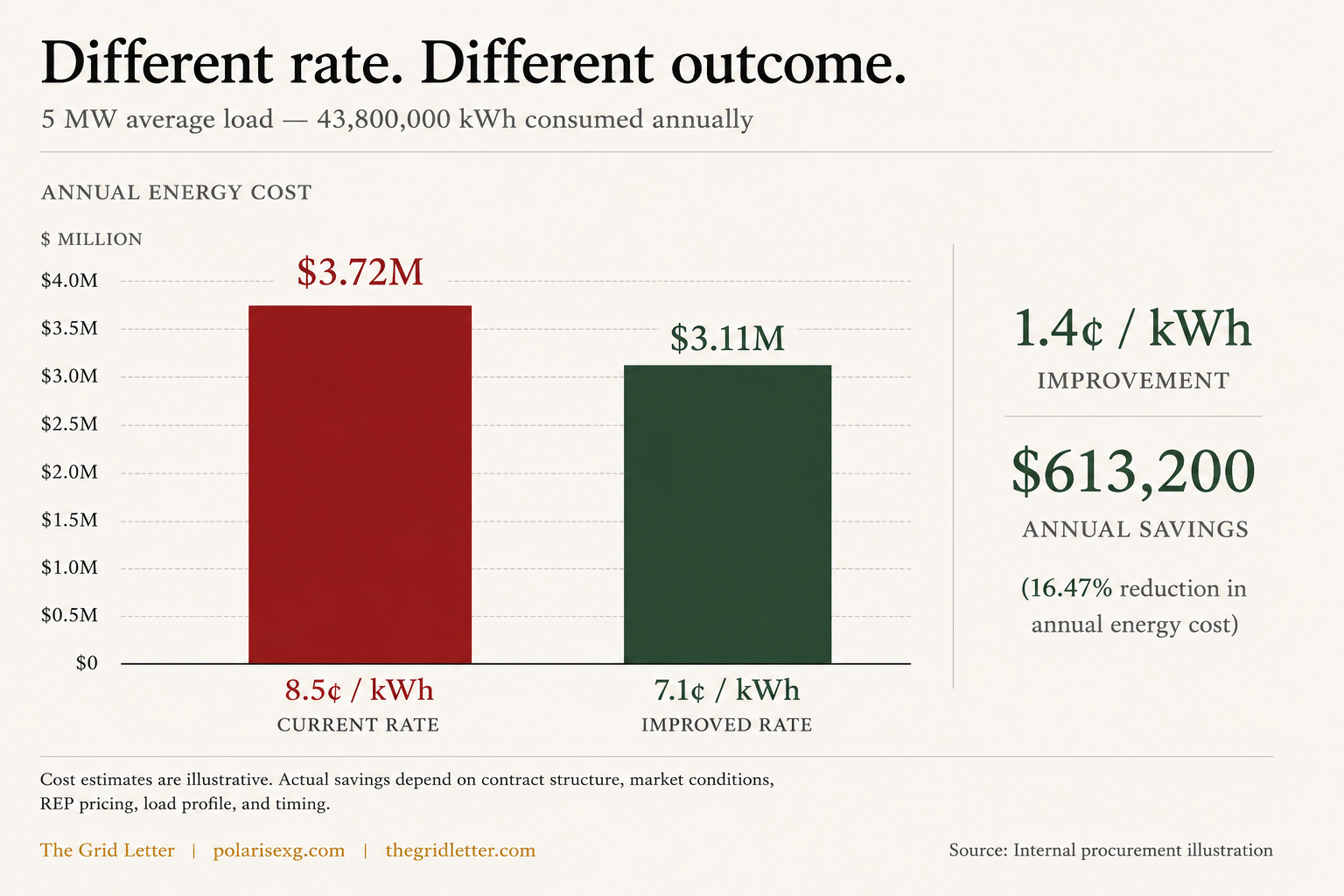
Downloading your interval data does not begin a sales process.
It does not change your electricity provider.
It does not obligate you to sign a new contract.
It simply gives you access to the same operating information used throughout the procurement process.
If you’d like a second set of eyes, Polaris offers Load Quality Assessments for commercial and industrial facilities. Which can be used independently to source better Texas electricity rates.
Upload your Smart Meter Texas interval data and we’ll benchmark your load profile, explain what the data says, and help you understand how it may affect procurement options through our network of retail electricity providers, including companies such as NRG, Constellation and ENGIE.
Whether you use that information yourself or decide to work with us is entirely your decision.
The objective is simple:
Turn your usage into a competitive advantage to save on power cost.
