

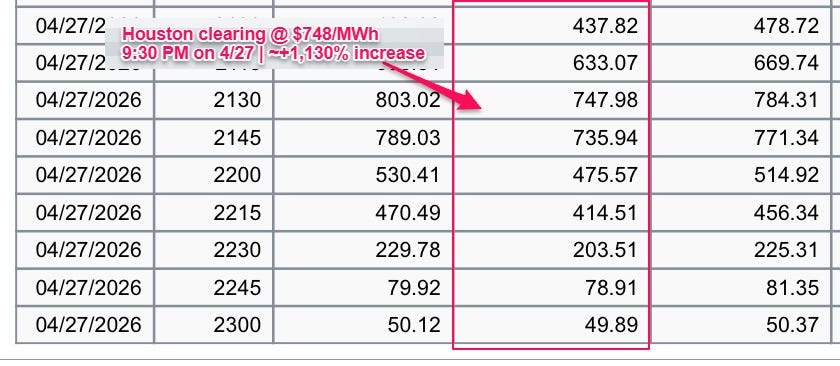
From $61/MWh to $748/MWh in 4 days. A 1,130% spike in price on a random week in April .
But what does this mean? Why should you even care? Is this getting better or worse? There’s a heap of questions one may ask when faced with this reality and the truth may not be what you want to hear (but will have to face).
Give me only 5 minutes of your day and I promise you won’t look at electricity the same.
Whether your just the average tax paying citizen or run a chain of commercial businesses. Everything I’m about to say will apply to every single person reading this. So pay attention.

On the evening of April 27th, Houston electricity customers paid an estimated $32 million above normal market rates in four hours. Not during a heat wave. Not during a “freeze” grid emergency. On a Monday night in spring, while most people were at home sleep with no idea what their meter was recording.
That number comes from ERCOT’s own public load data for the Coast weather zone, cross-referenced against real-time settlement prices from the same evening. The math is public, verifiable. The implication is the part nobody is talking about.
4CP season hasn’t even opened yet.
The Meter Was Running While You Weren’t Watching
The week of April 22nd produced three separate price events in the Houston wholesale market. Each one worse than the last.
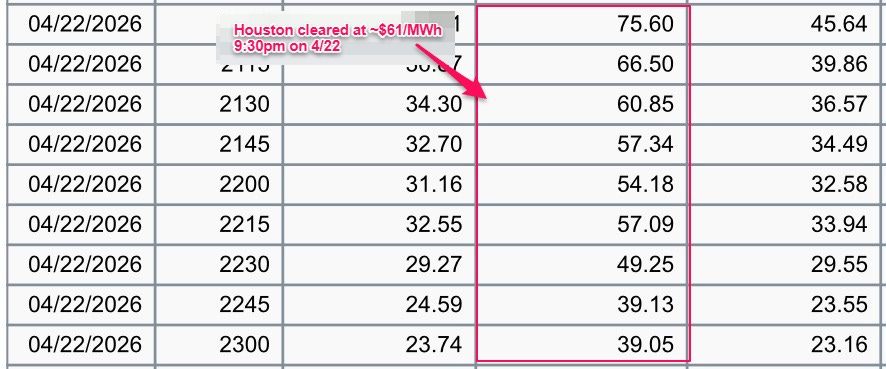
April 22nd, Monday evening: Houston cleared at approximately $61/MWh. Normal for that hour now runs $20 to $50/MWh, aligning with some claims (referenced below).
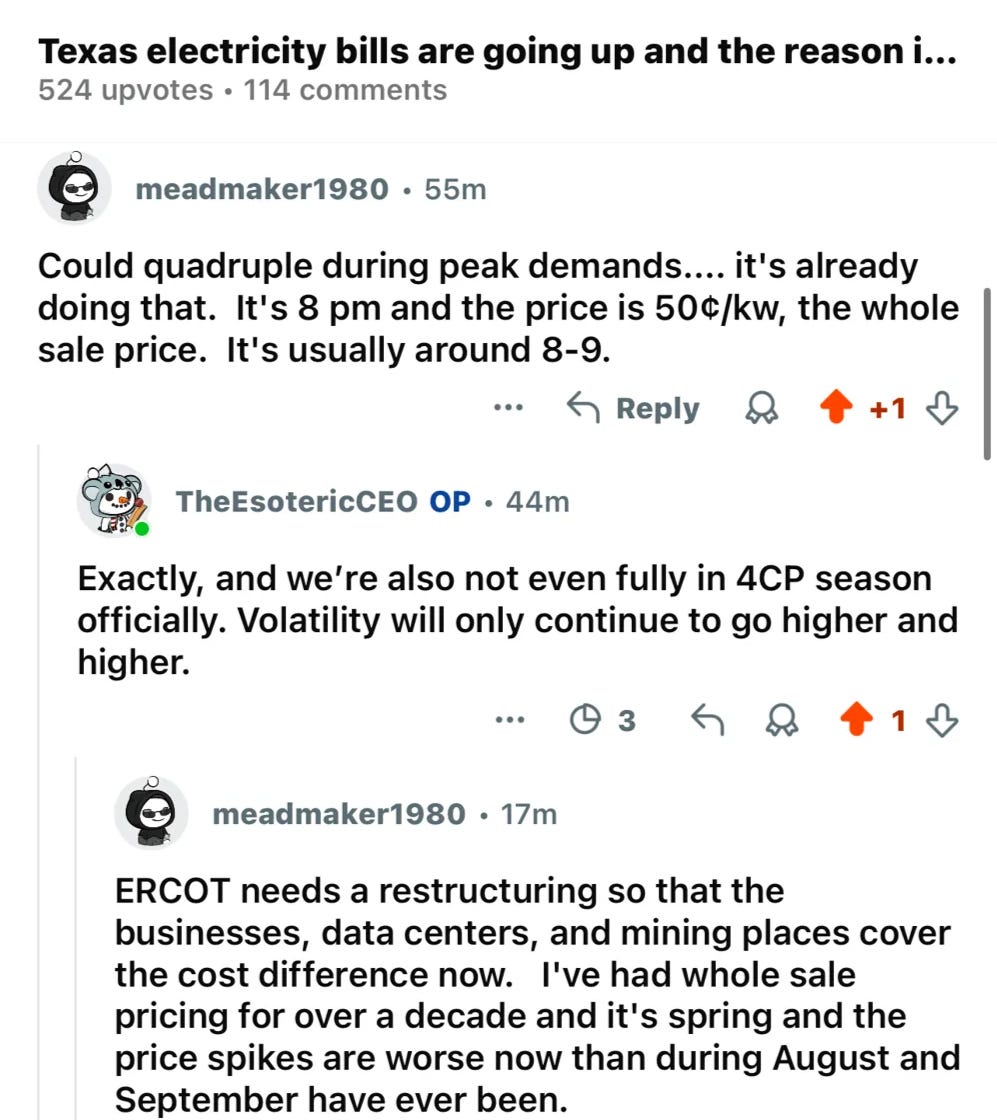
Post source: r/texas
Over a decade experience of wholesale pricing most never touch so imagine the feeling of those who were never even exposed to wholesale prices to begin with.
April 25th, Saturday afternoon, 1:15PM: no weather event, no grid emergency, no demand surge. Houston hub hit $96.83/MWh. Normal spring wholesale runs $25 to $35/MWh. Nearly 3 to 4x above baseline on a weekend afternoon in April.
Then April 27th arrived.
The settlement sequence from ERCOT’s own records: $495, $502, $565, $686, $803. That is not a flash spike. That is a sustained event running from 6:45PM through 9:45PM on an ordinary spring night. Houston hub average peaked at $803/MWh at 9:30PM. During that single hour, ERCOT’s load data shows the Coast zone carrying 17,119 MWh. At $803/MWh against a $40 normal evening baseline, that one hour cost Houston approximately $13 million above a normal Monday night.
Three events. Seven days. All before summer (4CP).
The Grid Isn’t Broken. It’s Working Exactly as Designed.
Someone with deep wholesale electricity experience dropped into my comments this week. His observation: spring 2026 price spikes are already worse than any August or September he has seen in his career. That is not a forecast. That is a pattern read from someone who has been watching this market for over a decade.
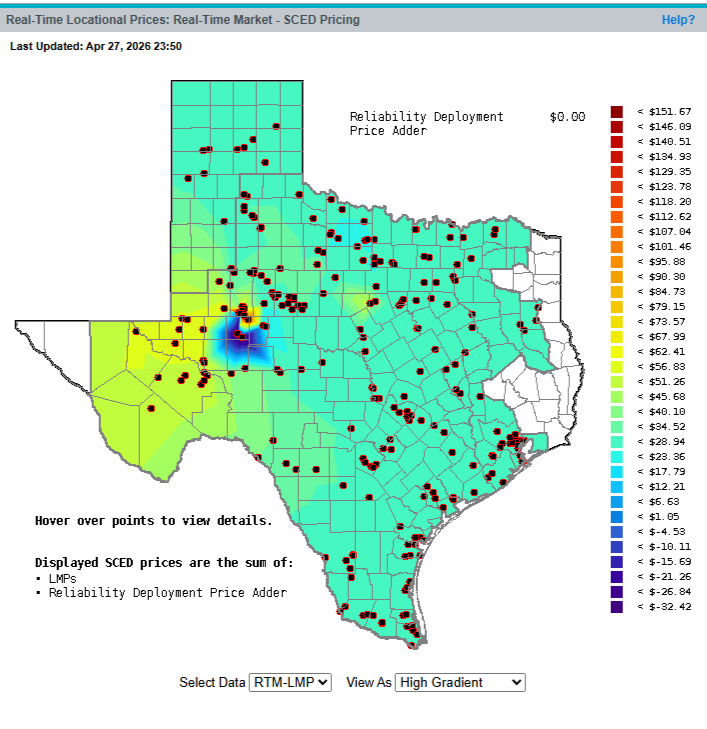
The same night Houston was printing $803/MWh, the Permian Basin was producing so much wind generation that prices went negative. Generators were paying to offload power they couldn’t move. Between that surplus and Houston’s demand sit roughly 400 miles of transmission infrastructure that was not built for what this grid is being asked to carry in 2026.
You are not paying high prices because there isn’t enough power. You are paying high prices because the power can’t get to you. That distinction matters, because one of those problems gets fixed eventually and the other one doesn’t.
The Actors Who Profit When You’re on Autopilot
While you’re auto-renewing and assuming it’ll sort itself out, the market is actively pricing against that assumption. Here’s who benefits when you’re not paying attention:
Retail electricity providers set renewal rates based on what the market will bear from customers who don’t shop. If you haven’t compared rates recently, your renewal price reflects that.
Suppliers with index-priced contracts passed every dollar of the April 27th spike directly to customers on variable or real-time pricing plans. No buffer. No warning.
Businesses that do shop are locking fixed rates right now, before summer forward pricing bakes in the peak premium. They will pay less than you next January for the same kilowatt-hours.
The transmission system itself charges you a capacity cost calculated from four specific peak hours each summer. Most commercial customers have never heard of this charge. The ones who have are managing their load around it.
Inaction is a choice. Right now, it’s an expensive one.
April Was the Warm-Up Act
Here is the mechanism most Texas business owners have never been shown.
ERCOT calculates a major portion of your commercial transmission costs using the four highest peak demand hours across the entire grid each summer, June through September. Those four hours are called the Four Coincident Peaks, or 4CP. Whatever load you are running during those four hours determines what you pay in transmission charges for the entire following calendar year.
Most commercial operators discover this in January. By then the season is over and the number is fixed.
4CP season opens June 1st. The three price events above, $61, $96.83, and $803/MWh, all happened before it did. Forward strip pricing for summer contracts is being set right now, off a baseline that already includes April’s volatility. Every week you wait to review your contract, you are pricing off a higher floor.
Thinking about it later is a position. It just costs more than thinking about it now.
Three Questions Worth Answering Before June
You do not need to become an energy analyst. You need five minutes and your most recent electricity bill to save you potentially hundreds to thousands this year.
1. What rate structure are you on?
Fixed, indexed, or variable. Those three words determine everything about your exposure to what happened on April 27th.
Fixed rate: you were protected. The spike passed you by.
Indexed or variable: you paid some version of that $803/MWh that evening. How much depends on your contract terms, but it showed up.
If you don’t know which one you’re on, find your contract or call your provider today. That single answer changes every decision that follows.
2. When does your contract expire?
Pull the date. Write it down.
If it expires between June and September, you are at risk of rolling into a default or variable rate during 4CP season, the most expensive window of the year to be unprotected. Renewing early on a fixed term, even at a slightly higher rate than last year, beats rolling into a variable plan mid-summer by a significant margin.
If it expires after September, you have time. Use it to shop properly before next spring.
3. Do you see a transmission or capacity line item on your bill?
If you’ve never noticed it, find your bill right now and look for terms like TDSP charges, capacity charges, or demand charges. They are there. Every Texas commercial customer pays them.
That line item is directly connected to 4CP. The four peak demand hours last summer set what you are paying on that line today. The four peak hours this summer are setting what you will pay next January. Most people find out after the fact. You don’t have to.
Those three answers cost you nothing to find. Acting on them before June is the entire difference between being ahead of this or behind it.
Want to go deeper on how ERCOT actually works and why it affects your bill the way it does?
Start here: Friend or Foe? A deep-dive into ERCOT
Sources: ERCOT Real-Time Settlement Point Prices, HB_HOUSTON hub, April 22–27 2026. ERCOT NP6-345-CD Actual System Load by Weather Zone, April 27 2026. ERCOT Real-Time Nodal LMP Heat Map, April 27 2026 23:50.
TheGridLetter translates what’s happening in the ERCOT market into plain language for Texas business owners. One issue per week. No jargon. No filler.
If this was useful, forward it to someone whose electricity bill you think about.
Issue #4 · April 29, 2026