
Access the ERCOT report: Monthly Outlook for Resource Adequacy (MORA)
October looks comfortable. The interesting part is when it doesn’t.
ERCOT’s October 2026 resource adequacy outlook begins with a relatively comfortable headline: under typical grid conditions, Texas is expected to have sufficient resources to meet electricity demand.
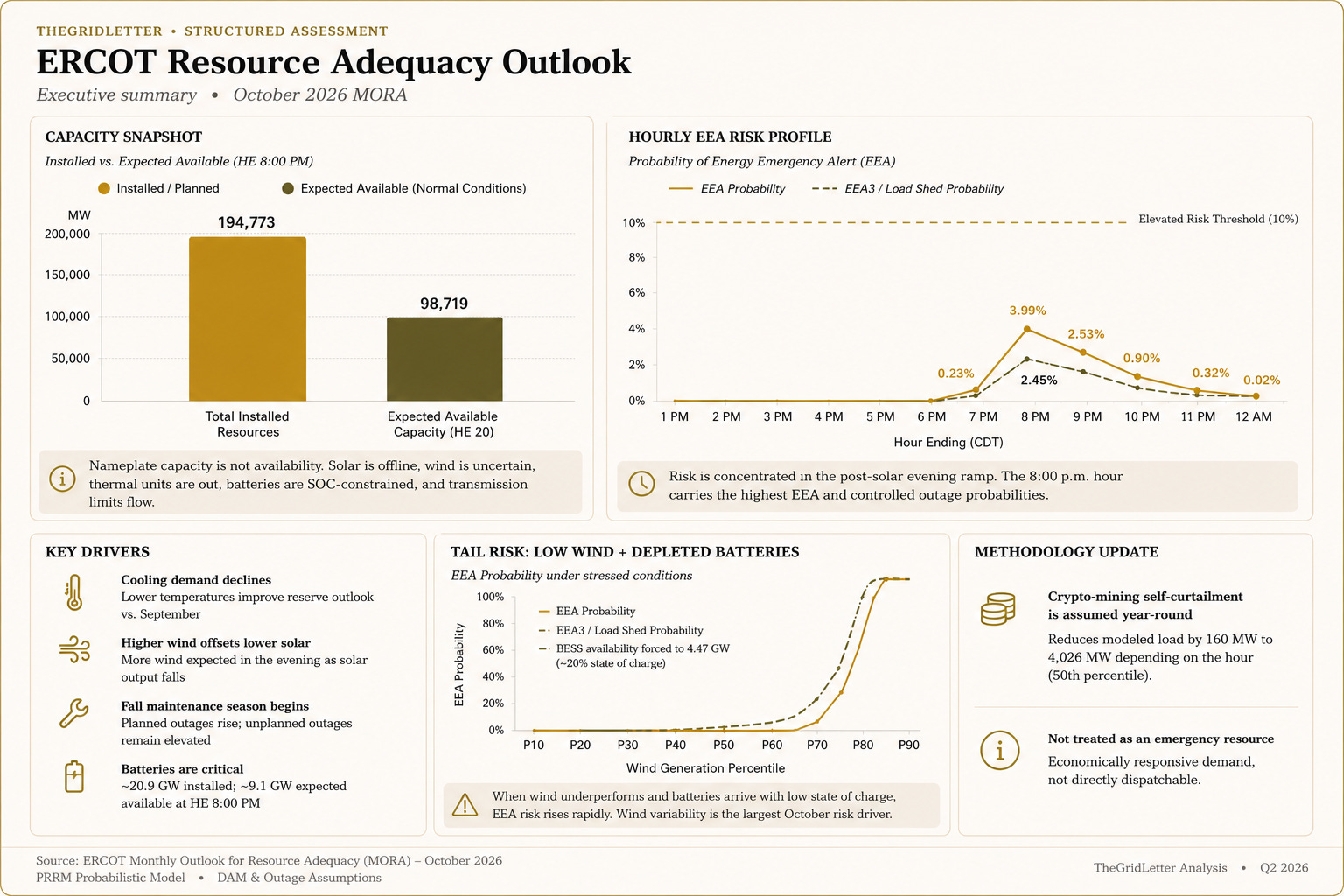
The system enters the month with nearly 195 GW of installed and planned resources. Yet during the hour ERCOT identifies as having the highest risk of an Energy Emergency Alert, 8 pm.; expected available capacity falls to roughly 99 GW against forecast demand of about 77 GW.
Even then, ERCOT’s modeled probability of entering emergency conditions peaks at just 3.99%, below the 10% level the grid operator uses to indicate elevated resource-adequacy risk.
So the October outlook is not primarily a story about Texas running short of electricity.
It is a story about when the resources Texas has are actually available.
That distinction is becoming more important as the ERCOT grid changes. Solar production falls rapidly in the evening. Wind output varies. Batteries can shift electricity from one part of the day to another, but their contribution depends on how much energy remains stored. And October brings the beginning of fall maintenance season for thermal generators.
The result is a grid with substantial generating capacity overall, but a resource-adequacy profile that can change considerably from one hour to the next.
Installed capacity is not the same as available capacity
That hourly shift is easiest to see by separating two numbers that are often treated as interchangeable: installed capacity and available capacity.
ERCOT lists 194,773 MW of installed and planned resources for October. But at 8 p.m., expected available capacity is 98,719 MW.
The difference does not mean half the fleet is simply offline. The two numbers describe different things.
Installed capacity describes the size of the resource fleet. Available capacity reflects what ERCOT expects can actually contribute during a specific hour after accounting for factors such as solar output, wind conditions, thermal outages, battery availability, transmission limits and other operating constraints.
By 8 p.m., solar production is effectively gone. ERCOT expects roughly 15.5 GW of wind and about 9.1 GW of battery capacity to be available, while thermal generation carries a much larger share of the system.
That makes the most useful way to read the October outlook fairly simple:
Installed capacity describes the fleet. Available capacity describes the hour.
For a grid adding large amounts of solar, wind and storage, that distinction is becoming increasingly important.
The risk is concentrated in a narrow evening window
Once availability is viewed hour by hour, October’s risk profile becomes much clearer.
ERCOT models very little emergency risk through most of the afternoon. The probability of an Energy Emergency Alert rises to 0.23% at 7 p.m., reaches 3.99% at 8 p.m., then falls to 2.53% at 9 p.m. and 0.90% by 10 p.m. The probability of reaching the more severe controlled-outage condition also peaks at 8 p.m., at 2.45%.
The important point is not that ERCOT expects an emergency at 8 p.m. It does not.
Rather, the modeling identifies a particular combination of conditions where the system becomes more exposed: solar production has fallen away, evening demand remains relatively high, thermal generators are entering fall maintenance season, and the grid becomes more dependent on wind, dispatchable generation and stored energy.
ERCOT identifies wind variability as the largest October risk factor. That makes the condition of the battery fleet particularly important, because storage can help bridge the evening transition, but only to the extent that energy remains available to discharge.
October’s risk, in other words, is less about sustained system tightness and more about what happens when several hourly conditions begin to overlap.
Batteries change the evening equation, but installed MW only tells part of the story
Storage is becoming increasingly important to ERCOT’s evening transition because batteries can move electricity from periods of abundant generation into periods when the system is tighter.
For October, ERCOT lists roughly 20.9 GW of operational battery capacity. At 8 p.m., however, expected battery availability is closer to 9.1 GW.
That gap matters because a battery’s nameplate capacity does not tell us how much energy is actually available during a specific hour. Its contribution depends on state of charge, duration, earlier charging conditions and whether it has already discharged into previous grid needs.
ERCOT’s low-wind sensitivity makes that dependence visible. In the stressed scenario, battery availability is fixed at about 4.5 GW, roughly half the expected 8 p.m. contribution under typical conditions. As wind output falls and batteries arrive with less stored energy, modeled emergency probabilities rise sharply.
That is not ERCOT’s expected October outcome. It is a stress test.
But it illustrates an important shift in how grid risk is forming: scarcity can become less about one missing resource and more about several conditions deteriorating at the same time.
The demand side of ERCOT is changing too
The same shift toward hourly conditions is beginning to appear on the demand side of the grid.
For October, ERCOT explicitly models a portion of cryptocurrency mining load as economically responsive, meaning some of that demand may reduce consumption when wholesale electricity prices rise high enough. Rather than assuming every megawatt of forecast demand remains fixed under stress, the model recognizes that certain large loads can change their behavior as market conditions tighten.
That distinction is becoming more important as Texas prepares for another wave of large electricity demand.
Data centers, industrial projects, cryptocurrency mining and other large loads are raising questions across ERCOT and the Texas Legislature about how quickly new demand should connect, how accurately it should be reflected in grid planning, and what role flexible consumption can play during periods of system stress.
The broader change is easy to miss. ERCOT has traditionally been discussed as a market where generation responds to electricity demand. Increasingly, both sides of that equation can move.
As batteries make portions of supply more time-dependent and some large consumers become more responsive to market conditions, understanding resource adequacy requires looking beyond how much generation Texas has, or how much electricity customers are forecast to consume.
It requires understanding which resources and which loads are available to respond when conditions tighten.
The market is becoming more conditional
October’s outlook does not suggest that ERCOT is entering the month short of power. Under typical conditions, the system appears adequately supplied.
What the report does show is that headline capacity is becoming a less complete way to think about reliability in Texas.
Nearly 195 GW of installed and planned resources can coexist with a much narrower set of resources actually carrying the system during the critical evening hour. Solar output changes with the clock. Wind can vary. Batteries depend on stored energy. Thermal availability changes with outages and maintenance. Large loads can increasingly respond to economic conditions.
That changes the question.
Instead of asking only whether Texas has enough generation, it is becoming more useful to ask:
What supply, storage and flexible demand will actually be available during the hour when the system needs them most?
That framework extends beyond October. It sits underneath many of the issues now shaping ERCOT and the broader Texas electricity market, from battery deployment and large-load growth to transmission planning and the policy debate around how rapidly the grid should adapt.
The Texas grid is getting larger.
But understanding it increasingly requires looking at timing, availability and interaction, not just total megawatts.
Read More From Us